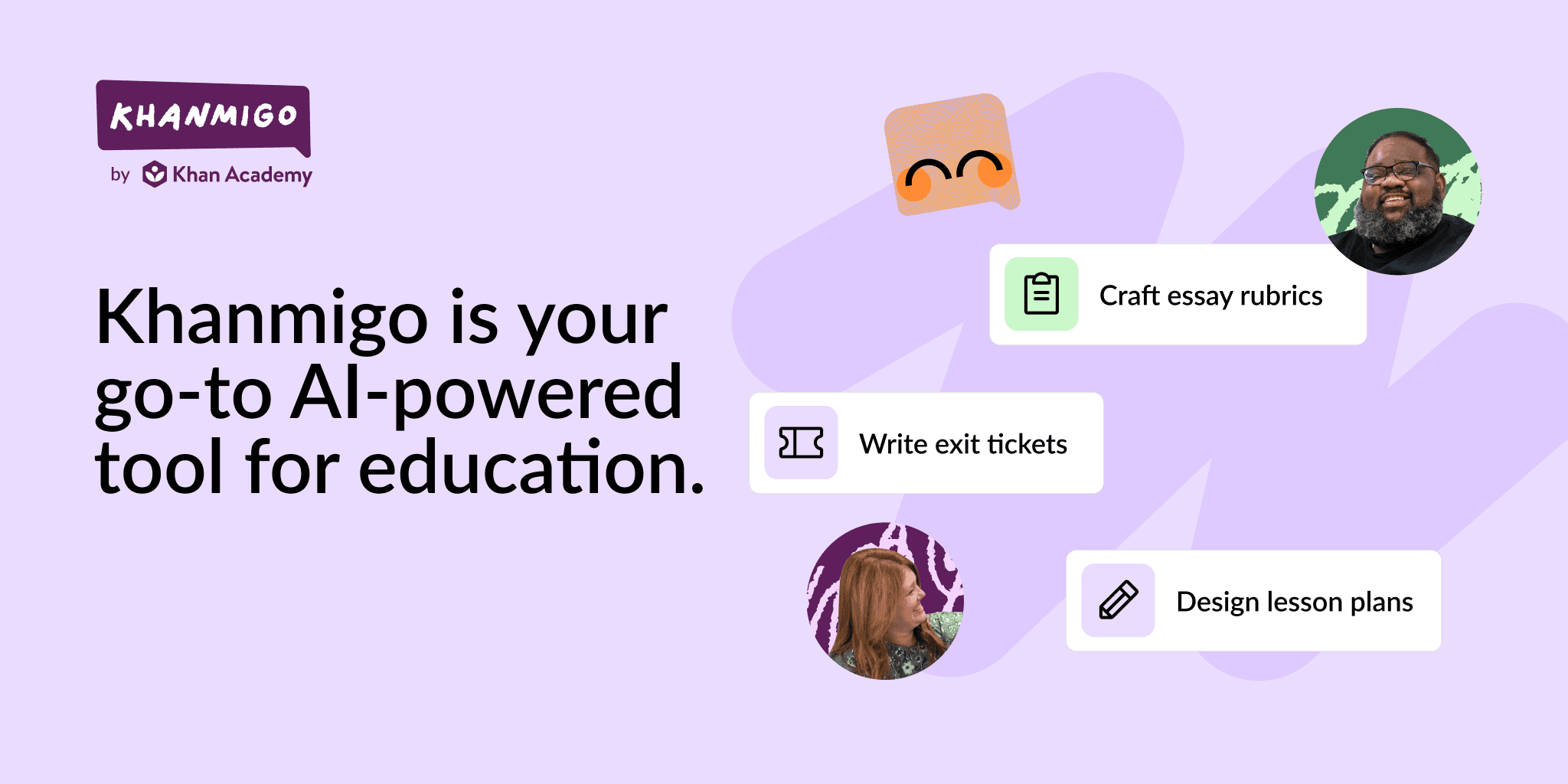
Khanmigo is Khan Academy's AI tutor and teacher assistant, free for educators in 180+ countries thanks to a 2024 Microsoft partnership. It guides students through problems using Socratic questioning rather than giving direct answers, covering K-12 math, science, humanities, and coding.
Khanmigo is an AI-powered tutoring and teaching assistant built by Khan Academy, the education nonprofit behind one of the world's largest free learning platforms. It launched in limited beta in 2023 and became widely available through 2024, running on GPT-4 technology via Microsoft's Azure OpenAI Service. Unlike general-purpose chatbots, Khanmigo was designed specifically around a Socratic pedagogy: instead of solving problems for students, it asks guiding questions and gives hints, coaxing learners toward answers they find themselves. This is not an accident of design; it is the entire point.
The tool splits into two distinct products. Khanmigo for Teachers is free in 180+ countries and handles the prep work that consumes teacher time: standards-aligned lesson planning, rubric generation, exit ticket creation, quiz building, differentiation suggestions, and student progress summaries. Khanmigo for Learners and Parents costs $4/month (or $44/year) and provides personalized tutoring across Khan Academy's full content library, covering everything from elementary arithmetic through college-level material, plus writing coaching, debate practice, historical figure role-play, and college admissions guidance. A district tier with custom pricing adds SSO integration, automatic rostering, dedicated support, and admin-level analytics. Mobile apps for iOS and Android bring the tutor to students outside the browser. School districts can also access the platform via API for deeper integration into their own systems.
What Khanmigo actually is in May 2026
By the 2025-26 school year, Khanmigo had moved from a bolt-on overlay to being embedded directly inside Khan Academy's main platform. AI guidance is no longer a separate tab you open; it surfaces contextually as students work through exercises and as teachers navigate their class dashboards. The AI is grounded specifically in Khan Academy's curriculum rather than the open web, which means its answers in math, science, and humanities stay tethered to the same pedagogy students encounter in the video lessons and exercises.
Adoption accelerated sharply in the 2024-25 academic year, with active student users jumping from roughly 40,000 to 700,000. Projections for 2025-26 exceed one million students. Hundreds of US school districts now have institutional agreements with Khan Academy, and the teacher product has expanded into Spanish, Vietnamese, and 30+ additional experimental languages since the initial English-only rollout. The platform has received a four-star rating from Common Sense Media, which evaluated it specifically as an AI learning tool and ranked it above general chatbots like ChatGPT for transparency, safety, and privacy practices. It is COPPA and FERPA compliant, which matters considerably for districts choosing tools for minors.
"It doesn't just give me the answer. Instead, it walks me through the steps." -- Sabrina, high school student review, Democratize AI, 2024
The teacher product focuses on reducing what Khan Academy describes as the 50%+ of a teacher's workload consumed by preparatory tasks. A teacher inputs a unit topic and grade level, and Khanmigo returns a draft lesson plan with differentiation suggestions, vocabulary scaffolding for struggling readers, and an exit ticket. What might take an hour of planning takes 15 minutes. Students in class can interact with literary and historical figures (Khanmigo generates in-character responses based on documented views), practice writing with targeted feedback, and work through any Khan Academy exercise with AI-guided hints.
Where Khanmigo sits versus Synthesis Tutor and Brilliant
Khanmigo's two most direct competitors address fundamentally different slices of the same market, which makes the comparison mechanical rather than just a question of preference.
Synthesis Tutor is a K-5 math tutor designed for ages 5-11, built by the team behind the SpaceX-affiliated experimental school Elon Musk founded. Its AI uses visual manipulatives: blocks, number lines, and multi-sensory presentations that explain the same concept from several angles. It was specifically engineered for neurodiverse learners and young children who experience math anxiety. Khanmigo, by contrast, is text-based and conversational. Its Socratic question-and-answer structure requires students to read fluently and respond in writing. That means Khanmigo works best from approximately age 9 or 10 upward, while Synthesis has a genuine advantage with younger children. Synthesis costs $20/month or $99/year, more than four times Khanmigo's learner price, and covers math only. Khanmigo spans every subject in Khan Academy's library and extends through college-level material. These are not substitutes; they serve different age brackets and learning styles.
Brilliant targets a different population: motivated teens and adults pursuing STEM depth. Brilliant's courses are structured as 15-minute interactive puzzle sequences: learners solve problems as the primary activity, with explanations surfacing only when errors occur. There is no free-form AI conversation; guidance comes through the lesson's built-in feedback mechanisms. Brilliant covers AI, quantum computing, machine learning, and advanced mathematics that exceed Khan Academy's scope. But it has no teacher product, no free tier, and no K-5 offering. It costs $13.99/month on an annual plan. Khanmigo is a reactive tutor that responds when students are stuck; Brilliant is a proactive curriculum that sequences learning whether or not students are stuck on anything. They can complement each other for older learners but are not direct substitutes.
For document-based homework help and general research assistance, students often use Coursera for structured course content or Quizlet for flashcard-based reinforcement alongside Khanmigo. For students struggling specifically with math problem sets shown via phone camera, Photomath fills a gap Khanmigo deliberately leaves open: it gives direct answers with step-by-step solutions shown visually, which Khanmigo refuses to do by design.
How AI actually works inside Khanmigo
The AI layer is not general-purpose. Khanmigo is constrained to work within Khan Academy's content graph, which means its answers in a math problem-solving session are anchored to the same concepts, definitions, and solution approaches used in Khan Academy's exercises. When a student asks about a geometry concept, Khanmigo's guidance aligns with the specific vocabulary and method used in the Khan Academy lesson on that topic, not whatever method the model might otherwise default to.
The Socratic approach is implemented as a refusal to state answers directly. When a student asks "what is the answer?", Khanmigo redirects: "What do you think the first step should be?" This is consistent and, when it works as intended, produces measurably better learning outcomes than simply reading a solution. The problem is that the implementation is imperfect in edge cases. A student who has already solved part of a problem correctly may find Khanmigo treating them as if they know nothing, failing to acknowledge the work they got right before questioning what they got wrong. Math education researcher Dan Meyer documented this in a widely shared 2024 analysis: students who correctly identified a y-intercept but reversed a slope were met with "Do you know what the slope-intercept form of a line is?" rather than "Your y-intercept is correct, let's look at the slope." Human teachers responding to the same scenario consistently started by acknowledging the correct work. Khanmigo did not.
For teachers, the AI operates differently: it generates content, not guided dialogue. Lesson plans, rubrics, and quiz questions are produced as drafts that teachers edit and approve. The AI reads the teacher's class data to surface which students are falling behind on which skills and what assignments might help. This is grounded in real student performance data rather than general pedagogy, which gives the recommendations more specificity than most generic AI writing tools.
"As your planning ally and instructional collaborator, Khanmigo leverages Khan Academy content to simplify AI for teachers. No prompting is required." -- Microsoft Education team, May 2024 partnership announcement
The friction users keep raising
The Socratic method, Khanmigo's defining feature, is also its most common complaint. Students who are genuinely stuck and need a worked example first, then explanation, find the question-and-answer loop frustrating. A student reviewer noted it feels "annoying rather than educational" when you simply don't know where to start and each answer attempt is met with another question. The design assumes students arrive with some foundational knowledge; when they don't, the method breaks down.
Math computation errors surface consistently across independent reviews. Testers in 2024 reported Khanmigo producing incorrect arithmetic, including one Hacker News user who noted the tool claimed 6 x 2 did not equal 12. More complex calculations in physics and advanced algebra fared worse. Khan Academy has implemented custom solutions and the problem has improved, but it has not disappeared. This is a meaningful limitation for a math tutoring tool.
Quality degrades outside the core Khan Academy curriculum. In subjects not deeply covered by Khan Academy's video library, Khanmigo reverts to a generic chatbot experience. Reviewers who tested it on AP Chemistry and advanced history topics found the interactions "feel more like a standard chatbot" with "awkward or repetitive prompts." The advantage Khanmigo has over just asking ChatGPT is largely absent outside the curated content.
No image upload is available. Students cannot photograph a worksheet, a textbook page, or a handwritten problem and ask for help. This is a notable gap compared to tools like Photomath, which is built specifically around visual math scanning, and even general-purpose AI assistants that now accept images as input. For students working from printed materials rather than digital content, this requires retyping every problem manually.
The learner subscription is US-only. Despite Khanmigo for Teachers being free in 180+ countries, the $4/month paid learner tier requires a US billing address. International families who want to subscribe cannot.
Who Khanmigo is for
The teacher product is an easy recommendation for any K-12 educator in a supported country. It is free, built on a trusted nonprofit platform with strong data privacy credentials, and genuinely saves time on the administrative and planning work that consumes classroom prep hours. Teachers do not need to learn prompt engineering; the interface uses structured templates designed for common teacher tasks.
The learner product is well-suited to middle and high school students who respond to being guided rather than told, who work primarily through Khan Academy's existing content, and whose families are in the US. For a student who has built a study habit around Khan Academy exercises, Khanmigo is a natural and affordable extension at $4/month. Common Sense Media's favorable rating on privacy makes it a responsible choice for parents of younger teenagers.
Skip Khanmigo when your child is under 9 or 10 years old (try Synthesis Tutor instead), when they need direct answers before explanations, when they are doing STEM beyond high school level (Brilliant is better calibrated for that audience), when their homework frequently involves photographing printed problems, or when you are outside the US and looking for a learner subscription. Districts adopting at scale should compare the free teacher tier against purpose-built district platforms, accounting for the SSO and rostering overhead that custom pricing entails.
User Reviews
No reviews yet. Be the first to share your experience!
Sign in to write a review.
Related articles
Guides and articles related to Khanmigo.
Replit Pricing Explained (2026): Core vs Pro and Effort-Based Agent Billing
Grok 4.3 API for Agents (May 2026): Pricing, Benchmarks, Migration
AI User Testing in 2026: The Tools That Test Your Product While You Sleep
Project Planning With Claude: Dependency Math and the Critical Path (2026)
Does API Cost More Than a Subscription for Claude Opus 4.8, GPT-5.5, and Grok?