
Zhipu GLM is an open-weight large language model family from Beijing-based Z.ai (Zhipu AI), built on a mixture-of-experts architecture. MIT licensed and self-hostable, the GLM-4.5 and GLM-4.6 generations offer 200K-token context, free API flash tiers, and benchmark results competitive with Claude and DeepSeek.
Zhipu GLM is a family of open-weight large language models built by Z.ai, the international brand of Beijing-based Zhipu AI, a startup spun out of Tsinghua University in 2019. The GLM series uses a mixture-of-experts (MoE) architecture and releases weights under the MIT license, meaning developers can self-host, fine-tune, and commercially deploy the models without royalty obligations or usage restrictions. The web interface lives at chat.z.ai; API access runs through bigmodel.cn and docs.z.ai. As of mid-2026, the active generation includes GLM-4.5 (released August 2025), GLM-4.6 (September 2025), and GLM-4.7 (December 2025), each representing an incremental but measurable leap in coding, reasoning, and agentic capability.
The core features are straightforward: 200K-token context windows (GLM-4.6 onward), a dual thinking/non-thinking mode for trading depth versus speed, multimodal vision support through the GLM-V variants, and full compatibility with OpenAI-compatible API clients, making it a drop-in replacement in tools like Cline, Roo Code, and OpenCode. Free flash variants (GLM-4.7-Flash, GLM-4.5-Flash) are available at no cost via API for lightweight tasks. Paid API access to the full GLM-4.5 costs $0.60/million input tokens and $2.20/million output tokens, roughly 5-6x cheaper than Claude Sonnet at comparable capability tiers. Open weights are on HuggingFace (zai-org/GLM-4.5, zai-org/GLM-4.6) and ModelScope, with vLLM and SGLang inference support built in.
Zhipu GLM at a glance, May 2026
The GLM family spans several active model variants. GLM-4.5 uses 355 billion total parameters with 32 billion active (MoE routing), a 128K-token context, and MIT licensing for commercial deployment. GLM-4.5-Air trims this to 106B total and 12B active, significantly reducing hardware requirements while preserving most benchmark quality. GLM-4.6 extended context to 200K tokens, improved token efficiency by roughly 15% over GLM-4.5, and achieved the top ranking on LMArena among open models at its September 2025 launch. GLM-4.7, released December 22, 2025, introduced "thinking before acting" behavior, a pre-action reasoning pause that produced a 38% improvement on the Humanity's Last Exam (HLE) benchmark over GLM-4.6. The multimodal GLM-4.6V (106B) and its smaller GLM-4.6V-Flash (9B, free for commercial use) add image understanding to the family. All models support Chinese and English natively, reflecting Z.ai's primary market and one of the family's genuine competitive edges for bilingual enterprise deployments.
What Zhipu GLM is actually good at
The benchmark numbers are the honest place to start. GLM-4.5 scored 98.2% on AIME 2025 math competition problems, matching Claude Opus 4 on that task. On tool-calling benchmarks, it outpaced Claude Sonnet 4 (90.6% vs 89.5%). On web browsing agent tasks, GLM-4.5 outperformed Claude 4 Opus (26.4% vs 18.8%). At GLM-4.6, coding performance on LiveCodeBench reached 82.8%, approaching Claude 4's mid-80s range. GLM-4.6 scored 93.9% on AIME 2025 and 82.9% on GPQA, essentially tied with Claude 4.5 on the latter.
For developers, the MIT license is the feature that changes the calculus. Self-hosting GLM-4.5 via Ollama or vLLM means no per-token billing, no usage policy review, and the ability to fine-tune on proprietary codebases. The 200K-token context handles large legacy codebases in a single request. Front-end generation is specifically praised: reviewers describe GLM-4.6 producing "visually polished front-end pages" with minimal cleanup required. For agentic workflows, the model integrates cleanly with Cline, Roo Code, and MCP-compatible setups via OpenAI-compatible endpoints.
"I've been using GLM-4.6 since its release this month. It's my new fav. [I've] cancelled Claude after using both services for two years." -- jhancock, Hacker News, September 2025
"GLM 4.7 is already ahead when it comes to troubleshooting a complex but common open source library built on GLib/GObject." -- greenavocado, Hacker News, March 2026
Chinese-English bilingual tasks are a distinct strength. Teams processing Chinese legal documents, financial reports, or customer data alongside English outputs will find GLM's native Chinese optimization more reliable than models trained primarily on English corpora.
Where Zhipu GLM breaks, the failure modes users keep hitting
The most reported friction is political content filtering in Chinese-language queries. Research published in PNAS Nexus (2026) confirmed that GLM models refuse to discuss Tiananmen Square, Hong Kong protests, and CCP criticism when prompted in Chinese, while the same questions in English may receive substantive responses. This language-dependent censorship is a product of Chinese government AI regulation (companies must certify refusals on specific topics before public deployment), not a technical limitation. The community has created abliterated and derestricted GGUF variants on Hugging Face and Ollama, but users who need politically unconstrained Chinese-language responses should evaluate alternatives carefully.
SWE-Bench Verified performance shows a real gap at the frontier: GLM-4.6 scored 68% versus Claude Sonnet 4.5's 77.2%. For complex repository-level debugging across large, unfamiliar codebases, Claude retains a meaningful edge. GLM-4.7 improved this, but the gap persists on GUI/browser control tasks and extended autonomous coding sessions.
Rate limits bite on the free tier. The flash API models are rate-capped for registered users, and the free chat.z.ai interface has weekly usage limits that frustrate power users who discover the model and try to push it hard before committing to paid access. The promotional $3/month Coding Plan pricing was removed on February 11, 2026, and prices were raised about 30% in early 2026, which generated friction among early adopters.
Ecosystem depth is thinner than OpenAI or Anthropic. There is no native browser extension, no mobile app, and the plugin/integration directory is sparse. Developers use it via OpenAI-compatible endpoints in third-party tools, which works reliably, but out-of-the-box consumer experience lags.
Zhipu GLM vs. Qwen vs. DeepSeek
Qwen (Alibaba) and GLM are the two strongest Chinese open-weight families, and their architectural differences matter for deployment decisions. Qwen 3.6-35B-A3B uses only 3 billion active parameters versus GLM-4.5's 32 billion active, making Qwen dramatically cheaper to run per inference call at comparable quality tiers. Qwen 3.6 Plus extends to a 1M-token context versus GLM-4.6's 200K, a meaningful gap for very long document tasks. In direct coding evaluation at GLM-4.5's launch, GLM achieved an 80.8% win rate against Qwen3-Coder in head-to-head tasks, but Qwen leads on SWE-Bench Verified per-FLOP efficiency. For teams running on tighter GPU budgets, Qwen is generally the leaner option; for raw benchmark quality per generation, GLM and Qwen trade wins by task type.
DeepSeek V3/V4 competes at the same frontier tier but with a dramatically larger model: approximately 1 trillion total parameters, requiring H100 or H800 GPU clusters to self-host at full scale. GLM-4.5 at 32 billion active parameters is far more accessible on smaller hardware, making self-hosting realistic for teams without hyperscale GPU access. On API pricing, DeepSeek is cheaper ($0.28/M input vs GLM-4.5's $0.60/M), and DeepSeek V4 leads raw coding benchmarks with 83.7% SWE-Bench Verified. DeepSeek also suffered a high-profile data breach in January 2025 that exposed user chat histories, an incident GLM has not had an equivalent of. Both models exhibit language-dependent political content filtering, though the specifics differ by topic and deployment context. For API-only usage where cost dominates, DeepSeek wins on price. For self-hosted deployment on mid-range hardware, GLM's smaller active parameter footprint is the practical advantage.
Against Llama (Meta) and Mistral, GLM's main differentiator is the Chinese-English bilingual training at scale and the 200K-token context at the frontier parameter tier. Llama 4's Scout/Maverick variants use dense transformer architecture rather than MoE, leading to different hardware tradeoffs. Mistral's open models remain strong for European multilingual use cases but do not match GLM's Chinese-language performance. Against Kimi (Moonshot AI), another Chinese open-weight competitor, GLM-4.6 and Kimi K2 are roughly matched on coding performance, with Kimi offering a slightly larger 256K context versus GLM-4.6's 200K, while GLM shows better token efficiency.
Is the paid tier worth it?
For most individual developers, the free tier is a genuine starting point, not a trial. GLM-4.7-Flash and GLM-4.5-Flash are available at zero cost via API and handle a wide range of formatting, summarization, and lightweight coding tasks without charge. The free chat.z.ai web interface provides access to the full-quality models with weekly caps.
The Coding Plan subscription (Lite at approximately $10/month, Pro at $30/month, Max at $80/month) makes sense for teams using GLM-4.6 or GLM-4.7 as a primary coding assistant, where the per-token API cost would exceed the subscription threshold. For API-heavy production workloads, pay-as-you-go at $0.60/M input tokens is cost-effective compared to equivalent closed-source alternatives. At $2.20/M output tokens versus Claude Sonnet 3.5 at roughly $15/M output, the math favors GLM for high-volume generation tasks even at paid rates.
The open weights are the sleeper value. Self-hosting GLM-4.5 via vLLM on a leased GPU cluster eliminates per-token costs entirely. For teams with predictable, high-volume inference loads, the MIT license means the total cost of ownership can drop below even the cheapest hosted API options over 6-12 months.
Best use cases (and when to skip it)
GLM fits best for: developers building self-hosted agentic pipelines who need MIT-licensed weights they can fine-tune on proprietary code; bilingual Chinese-English enterprise teams processing documents at scale; researchers working on heavy math and logic tasks (AIME-level competition problems); and cost-sensitive teams running high-volume API workloads where Claude pricing is prohibitive.
Skip GLM when: your users primarily write in Chinese and need to discuss politically sensitive topics (the content filtering is regulatory, not configurable through the official API); your workflow depends on GUI/browser automation where Claude Sonnet 4.5 remains the benchmark leader; you need a polished consumer product with a mobile app and browser extension; or your team needs frontier-level SWE-Bench Verified performance at any cost (where Claude Sonnet 4.5 at 77.2% still leads GLM-4.6's 68%).
Getting started with Zhipu GLM
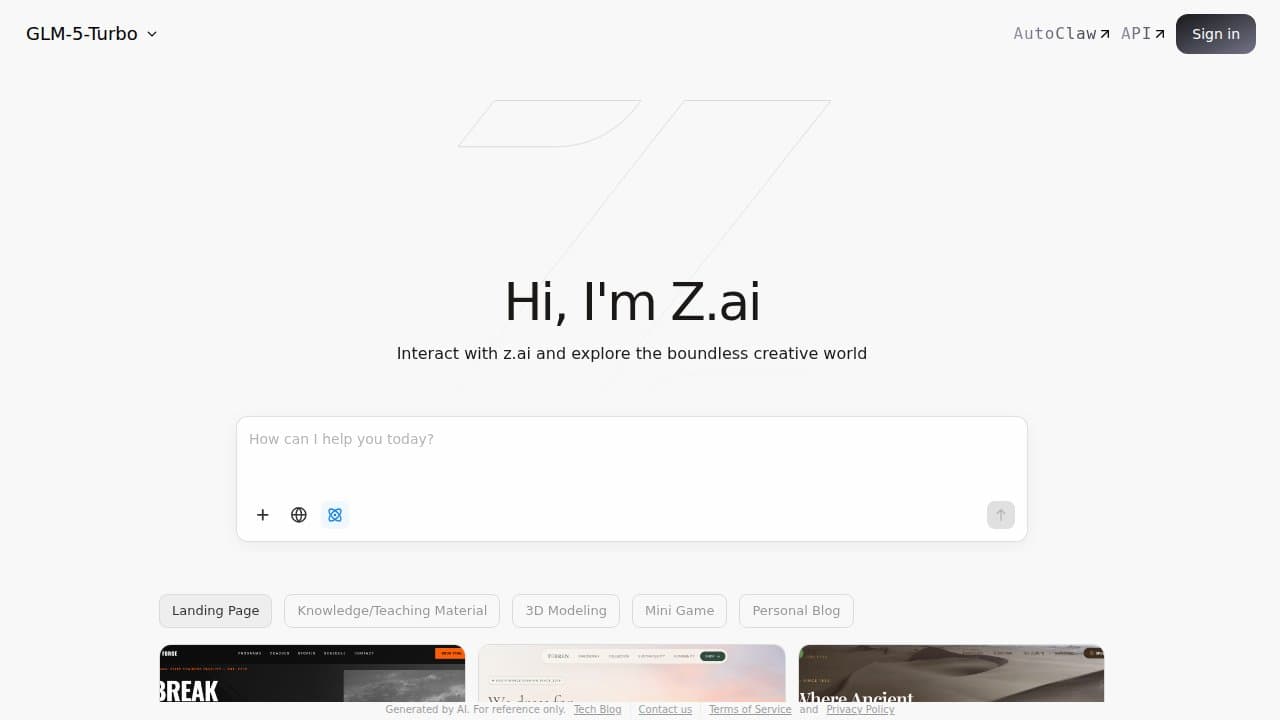
The fastest path is chat.z.ai, which requires free registration and provides immediate access to the full-quality models with weekly usage caps. For API access, register at bigmodel.cn or docs.z.ai, which issues an API key compatible with OpenAI-format clients. To point Cline or Roo Code at GLM-4.6, set the base URL to the Z.ai endpoint and drop in the API key, no configuration changes needed beyond that.
For local deployment, GLM-4.6 weights are on HuggingFace at zai-org/GLM-4.6 and available as GGUF quantized versions on Ollama (ollama pull glm-4.6). The 32B-active MoE model runs on machines with 40-80GB VRAM at full precision; 4-bit quantized versions drop to 20-24GB, making it viable on dual-consumer GPU setups. vLLM and SGLang are the supported inference frameworks for production self-hosting. The GLM-4.5-Air variant (12B active) is the recommended starting point for teams with tighter hardware budgets who still want open-weight models rather than the flash API tier.
User Reviews
No reviews yet. Be the first to share your experience!
Sign in to write a review.
Featured in collections
Curated lists that include Zhipu GLM.
Related articles
Guides and articles related to Zhipu GLM.
Grok 4.3 API for Agents (May 2026): Pricing, Benchmarks, Migration

Nous Hermes 4: The Self-Hosted Open-Weight Agent Brain (2026)
Vantaige Launches the LLM VRAM Calculator: A Free GPU Compatibility Finder for Open-source and Open-Weight AI
Google Vision AI Explained (2026): Pricing Per 1,000 Units, Free Tier, and Alternatives

Local Agentic Coding May 2026: Qwen 3.6 + BeeLlama.cpp + Star Elastic