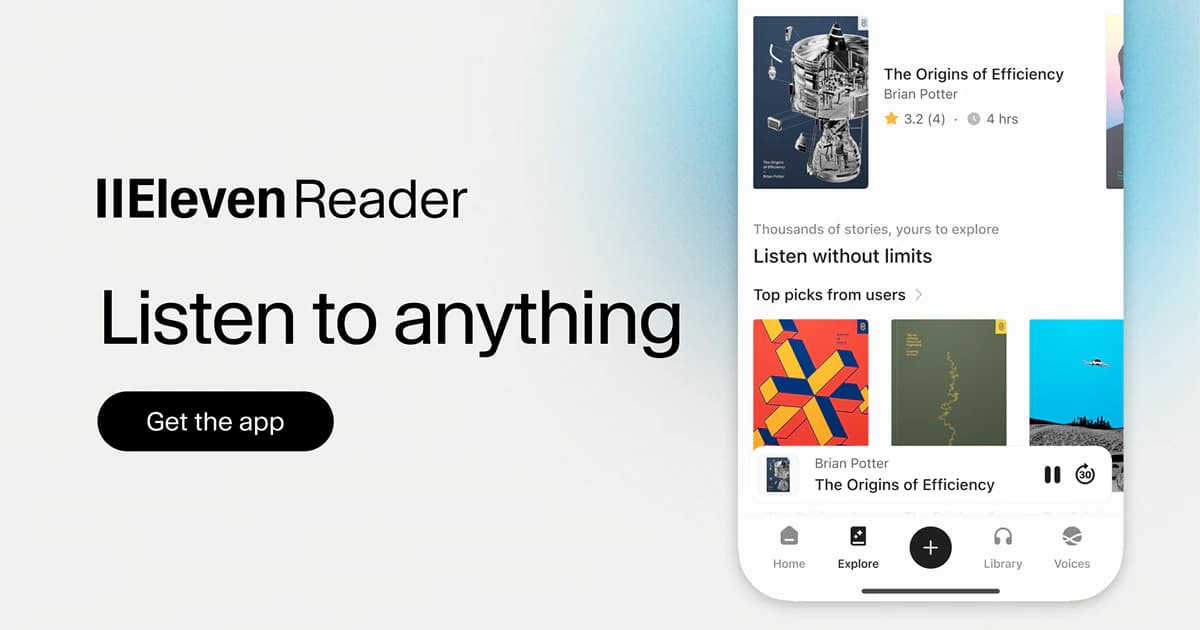

ElevenReader is ElevenLabs' own mobile reading app, converting any text into audio with 800+ premium AI voices. Free tier includes 10 hours/month. The GenFM feature turns your documents into AI-hosted podcasts in seconds.
ElevenReader is the consumer reading app built by ElevenLabs, the company that makes the AI voice platform used by millions of developers and publishers. It launched on iOS and Android in June 2024 and lets you listen to PDFs, EPUBs, articles, web pages, and pasted text using the same high-quality voice models that ElevenLabs licenses to production audiobook studios. The core pitch is simple: every document you own, read aloud by AI narration good enough that most listeners cannot tell it from a real person.
The app supports 32 languages and over 800 voice options, including the Iconic Voices collection of licensed celebrity likenesses. Formats supported include EPUB, PDF, URL import, image scanning, and clipboard paste. The November 2024 GenFM feature converts any document into an AI-hosted two-person podcast, making it a direct alternative to Google's NotebookLM Audio Overviews. Ultra plan subscribers get custom voice creation, offline downloads, and smart file imports that automatically strip headers, footers, and boilerplate before reading begins. Pair ElevenReader with the full ElevenLabs platform if you also need audiobook production or voice API access for your own projects.
What ElevenReader produces in April 2026
ElevenReader's output is audio playback, not a file export. You import text and the app reads it to you in real time using streaming synthesis from ElevenLabs' voice models. As of April 2026, the voice catalog runs to 800+ options. The standard library covers professional narrator voices across 32 languages. The Iconic Voices collection adds licensed likenesses of deceased public figures, voiced using ElevenLabs' cloning technology applied to historical recordings.
The GenFM feature, launched November 27, 2024, generates a full conversational podcast from any uploaded content. You import a PDF or article, tap Generate Podcast, and within seconds ElevenReader produces a multi-minute dialogue between two AI co-hosts who summarize, discuss, and contextualize the material. The co-hosts are matched to the content's tone: technical papers get a different voice pair than narrative essays. TechCrunch covered the launch as a direct response to NotebookLM's Audio Overviews feature, and that framing is accurate. The difference is that ElevenReader's voice quality is measurably higher, while NotebookLM integrates more directly with Google's document ecosystem.
Playback controls include adjustable speed (up to 4x), sleep timer, bookmarks, and word-synchronized highlighting that traces the narration across the text on screen. The word-sync feature is one of the most consistently praised aspects of the app among users with dyslexia or reading-related accessibility needs, since it lets them follow along visually while listening at higher speeds.
"I haven't found a voice yet that doesn't sound like it's a real person reading back to me. I've tried Speechify, NaturalReader, and a few others -- nothing comes close to how natural the voices in ElevenReader are." -- TTS productions 1200, Apple App Store, December 2024
The web app was added in summer 2025, expanding availability beyond mobile. A Chrome extension handles link and article imports from the browser. Cross-device sync keeps your reading position consistent when you switch between phone and desktop, though users have reported position drift in some update cycles (covered in the frustrations section below).
Where ElevenReader sits versus Speechify and Audioread
The TTS reader category has three meaningful tiers: Speechify at the top by market share, ElevenReader leading on voice quality, and Audioread occupying a specific RSS-delivery niche. Each uses a different technical model and serves a different primary user.
Speechify is the market leader with 50 million users and won the Apple Design Award at WWDC 2025. It offers 1,000+ voices in 60+ languages, a Mac desktop app, and a Chrome extension with deep web clipping. The defining mechanical difference is that Speechify treats reading and writing as a combined workflow: users can voice-type while reviewing content they are listening to. ElevenReader has no dictation mode at all. Speechify also has active celebrity voice licensing deals with living personalities, while ElevenReader's Iconic Voices collection focuses on historical figures. On voice naturalness, most audio-quality reviewers rate ElevenLabs' models above Speechify's proprietary synthesis, particularly for narrative fiction and complex sentence structure. Speechify's annual plan runs approximately $139/year ($11.58/month) versus ElevenReader Ultra at $99/year ($8.25/month). If you need a unified read-and-write environment with maximum platform breadth, Speechify wins. If voice realism is the priority, ElevenReader wins. For broader context on the voice synthesis platform itself, see the Murf AI and PlayHT listings for how enterprise TTS compares on the production side.
Audioread takes a completely different delivery approach. Instead of requiring its own app, Audioread converts your documents into a private RSS podcast feed that works in Apple Podcasts, Spotify, Overcast, Podcast Addict, or any podcast player. You send it a PDF or article and subscribe to your personal feed in whatever player you already use. Audioread costs $15/month, covers 18 languages, and processes up to 100,000 words per file. The key mechanical limitation: Audioread does not offer voice cloning, a custom voice catalog, or anything equivalent to ElevenReader's 800+ voice library. It uses "ultra-realistic" voices but does not disclose the underlying synthesis model. There is no GenFM-style podcast generation -- Audioread reads your content verbatim, it does not summarize or reformat it. If you want your reading queue to live inside your existing podcast app without managing another separate application, Audioread serves that use case better. ElevenReader wins on voice quality and generative features; Audioread wins on delivery flexibility. See also the Audioread listing for the full breakdown.
The licensing and copyright reality
ElevenReader is a playback application, not an audiobook production tool, so most copyright concerns apply to the underlying ElevenLabs platform rather than the reader app itself. For personal listening, importing your own legally owned EPUB or PDF is straightforward. The app does not export audio files -- it streams synthesis to your device only, which limits redistribution risk.
The Iconic Voices collection involves licensed likenesses of deceased public figures. ElevenLabs has worked with estates and rights holders, but the specific agreements are not published. Users who work in journalism, education, or any field with sensitivity around historical figures should be aware that the technology exists in the app, even if they choose not to use those voices for personal reading.
ElevenReader's content processing is server-side. When you upload a PDF, ElevenLabs processes the text on their infrastructure. Their privacy documentation states that uploaded content is not used to train public or third-party models, but users in sensitive industries (legal, medical, corporate) should review the current privacy policy before importing confidential documents. This is a limitation shared with every cloud-based TTS service, not unique to ElevenReader.
The GenFM podcast generation feature adds a wrinkle: the AI summarization and dialogue generation are based on the document you upload, but the co-host voices are ElevenLabs-generated characters. The output is clearly labeled as AI-generated in the app. There are no copyright licenses currently required for generating a personal podcast summary for private listening, but rebroadcasting GenFM output publicly would enter contested territory around both the voice likenesses and the summarized source material.
Where ElevenReader reliably falls short
The most consistent technical complaint is playback reliability. Multiple App Store reviews and threads on the AppleVis accessibility forum document sessions halting mid-document, requiring manual restart. A related bug causes the app to jump users backward -- sometimes by dozens of pages, sometimes by a full hour of listening -- when they resume a session. ElevenLabs has acknowledged playback issues in developer responses and shipped fixes, but the problem recurs across update cycles. For users who depend on TTS for accessibility, these interruptions are more than inconvenient.
PDF handling degrades with complex file structures. Large academic PDFs with multiple columns, footnote-heavy layouts, or scanned pages produce extraction errors. EPUB uploads can also fail silently on some file structures. The smart import feature on Ultra improves things for clean documents, but users with research-heavy workflows report that roughly one in four complex PDFs requires re-import or manual text paste instead.
"I love the quality and the interface. But it simply fails too often. Playback halts after 1-2 minutes and I have to restart. This is frustrating enough that I question whether to keep it." -- Aviel.P, Apple App Store, July 2024
The accessibility community -- a natural core user base for any TTS app -- has raised specific concerns. The AppleVis forum contains multiple threads about the sudden shift from unlimited free access to the metered 10 hours/month free model, which happened without advance notice. Feature requests like Bookshare integration (a major library service for print-disabled users) have gone unaddressed. The perception that developer feedback from this community goes unanswered on Discord has damaged trust among users who have the most to gain from a high-quality accessible reading app.
Cross-device sync loses position on some update cycles. Switching between iPhone and the web reader can place users at a different point in their document. This is a solvable engineering problem but has persisted through multiple releases as of early 2026.
Who ElevenReader is for
ElevenReader earns its place for mobile readers who want the best-available AI narration quality and are willing to pay $8-11/month for it. The free 10 hours/month tier is generous enough to genuinely test the app before committing. For anyone who listens to a book's worth of material each month as part of a commute or exercise routine, the Ultra plan competes favorably on per-hour cost against audiobook subscriptions.
Users with dyslexia, low vision, or reading fatigue are the strongest natural fit. The combination of word-synchronized highlighting and ElevenLabs' voice naturalness is specifically effective for comprehension-while-listening workflows. No other mobile TTS app currently matches this combination.
GenFM positions ElevenReader well for students, researchers, and heavy nonfiction readers who want to consume long documents more efficiently. Converting a 40-page PDF into a 12-minute conversational podcast is a legitimate workflow that Speechify cannot match and Audioread handles only partially (verbatim reading, no generative summarization). This overlaps with use cases served by ElevenLabs' full platform for production work, but ElevenReader keeps it accessible to non-technical users.
Skip ElevenReader if you need your reading queue inside an existing podcast app without managing another application -- Audioread handles that use case more cleanly. Skip it if you need voice typing, dictation, or a unified read-and-write environment -- Speechify's broader platform covers that. Skip it if your document intake is dominated by complex multi-column PDFs or scanned pages, where the extraction failures will frustrate you more than the voice quality will delight you. And skip the free tier as a long-term solution if you're an accessibility-dependent user; 10 hours/month is a real ceiling that will constrain daily use.
User Reviews
No reviews yet. Be the first to share your experience!
Sign in to write a review.
Related articles
Guides and articles related to ElevenReader.

The Personal AI Productivity Stack (2026): One Tool Per Job, Nothing Extra
Replit Pricing Explained (2026): Core vs Pro and Effort-Based Agent Billing
Google Vision AI Explained (2026): Pricing Per 1,000 Units, Free Tier, and Alternatives
Turn Any AI Agent Into a Superagent: The 12-Integration Stack (2026)
OpenAI GPT-Realtime-2 (May 2026): Pricing, Latency & 30-Min Voice Agent