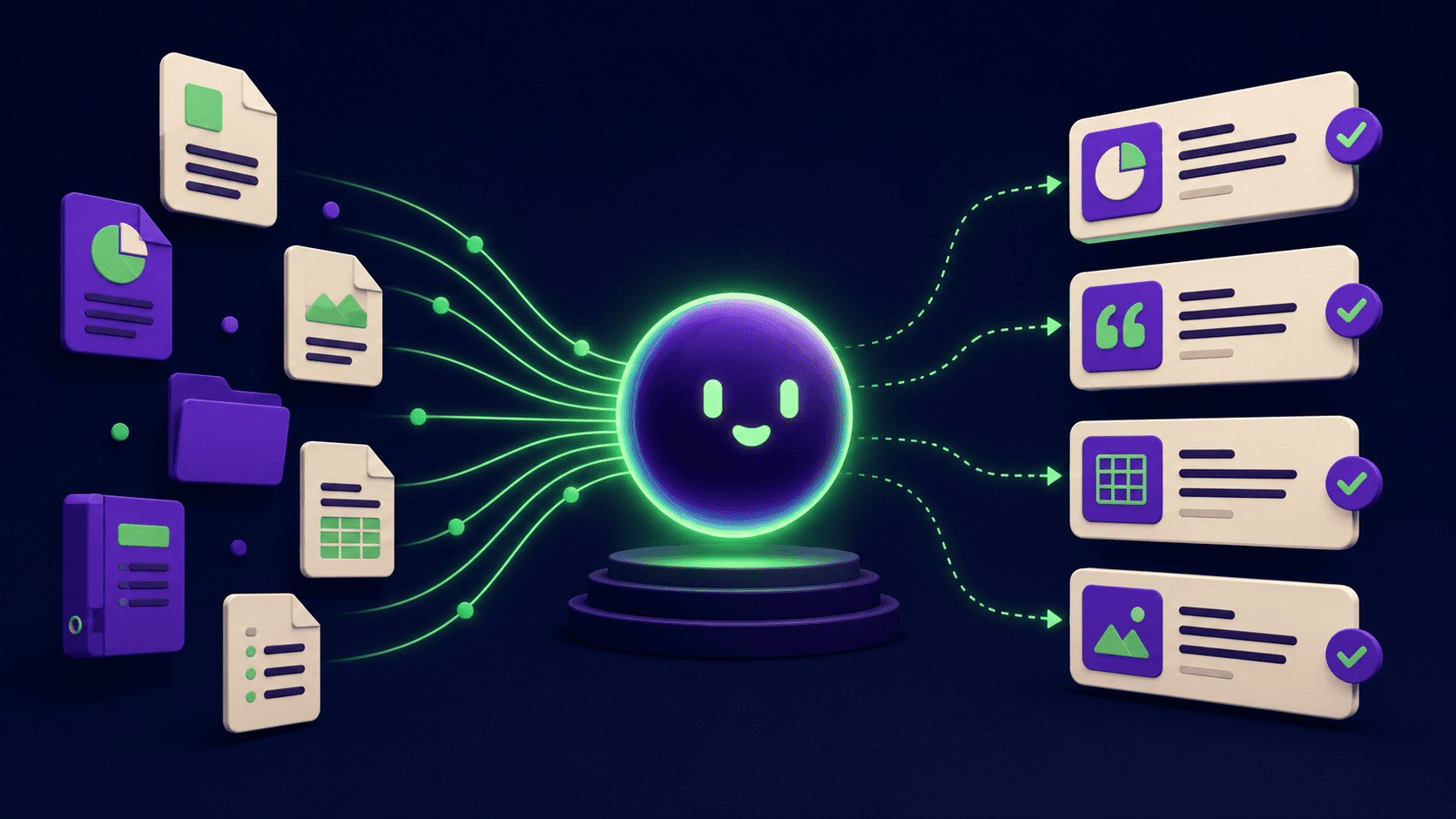

LlamaParse is LlamaIndex's cloud document parsing API for RAG pipelines. It converts PDFs, DOCX, PPTX, and 130+ formats into LLM-ready markdown or JSON with table, chart, and image extraction. Free tier includes 10,000 credits per month.
LlamaParse is LlamaIndex's proprietary document parsing API, built specifically to turn PDFs and complex business documents into clean, structured text that language models can actually use. Developed by run-llama (co-founded by Jerry Liu and Simon Suo, San Francisco), it launched in public preview on February 20, 2024, alongside the LlamaCloud platform, and reached general availability in March 2025 after raising a $19M Series A. The core problem it solves is the gap between how documents look and how LLMs need data: raw PDFs with embedded tables, multi-column layouts, charts, and footnotes routinely break naive text extraction, and LlamaParse applies vision-language models to preserve that structure in the output.
The API handles 130+ file formats including PDF, DOCX, PPTX, XLSX, HTML, and scanned images. It delivers results as layout-aware markdown, plain text, JSON with custom extraction schemas, or spatial text with coordinate data. Four parsing tiers let teams trade cost against accuracy: Fast (1 credit/page for plain-text documents), Cost Effective (3 credits/page for standard workloads), Agentic (10 credits/page for complex layouts), and Agentic Plus (45 credits/page for maximum accuracy using GPT-4.1 or Gemini 2.5 Pro). A free tier provides 10,000 credits per month, enough to parse roughly 3,300 pages at Cost Effective tier or 1,000 pages at Agentic tier without spending anything. Alongside its LlamaIndex framework, LlamaParse connects naturally to RAG stacks built on tools like Pinecone, Weaviate, and AnythingLLM.
What LlamaParse actually does in May 2026
LlamaParse V2, released December 18, 2025, simplified the entire configuration system after user research showed the original parameter-heavy interface was burdening engineering teams. The four-tier system replaced what had been a maze of parsing modes, LLM provider selections, and dozens of optional toggles. Teams that have already shipped to production can now pin their parsing to a specific date's model behavior using the YYYY-MM-DD format, so a model update does not silently change output structure mid-pipeline.
The May 2025 update added automatic orientation and skew detection: documents scanned at 90, 180, or 270 degrees are corrected automatically, and subtle page tilts between 1 and 12 degrees are also handled. Each parsed page now carries a confidence score from 0 to 1 that compares character counts and word overlap for text-heavy pages or runs OCR analysis for image-heavy ones. Teams can set a page_error_tolerance threshold and define whether failed pages return raw fallback text, a blank, or an error message.
Beyond parsing, LlamaParse covers an increasingly wide extraction surface. The Extract product accepts a JSON schema defined in natural language and fills it from document content automatically, replacing manual data entry. Classify and Split can route documents into labeled categories and segment concatenated PDFs. Sheets handles Excel and spreadsheet ingestion. Index provides a hosted vector search pipeline managed through the LlamaCloud dashboard. All six products share one API key and one billing account.
Access is through the Python SDK (pip install llama-cloud>=2.1), the TypeScript/Node SDK, a REST API, or directly from a web UI. The API also works as an agent skill inside AnythingLLM, Claude Code, and Cursor, so developers can trigger document parsing from inside their existing agent loops without a separate integration step. For teams already on LangChain or Firecrawl, LlamaParse output drops into existing pipelines without a format translation layer.
Where LlamaParse sits versus Reducto and Unstructured.io
Reducto and Unstructured.io are the two most relevant alternatives, and they approach document parsing from completely different angles.
Reducto uses a multi-pass correction architecture: computer vision segments the layout, OCR reads the text, a vision-language model adds contextual interpretation, and then a proprietary Agentic OCR loop re-examines the OCR output specifically to catch and fix errors. That self-correction step is the key mechanical difference. Reducto's own RD-TableBench claims up to 20% higher parsing accuracy on real-world documents with complex, merged, or rotated tables. It supports 100+ languages versus LlamaParse's narrower coverage, holds SOC 2 and HIPAA certification, and offers on-premises deployment without requiring an enterprise contract. The trade-off is cost and accessibility: Reducto has no public free tier and is primarily positioned at enterprise teams with high-stakes accuracy requirements, such as financial services firms parsing dense 10-K tables.
Unstructured.io takes a different architectural path entirely. Its output is not LLM-ready markdown by default; it labels document elements semantically (title, narrative_text, table, image, etc.) so developers can write their own chunking logic based on element type. The platform ships with 71+ pre-built connectors spanning cloud storage, databases, and vector stores. Its SaaS deployment claims throughput of over 15 million pages per hour per workflow, scaling to petabytes. It offers both an open-source core that teams can self-host for free and an enterprise SaaS with in-VPC deployment. LlamaParse generates output that is immediately consumable by an LLM with minimal post-processing; Unstructured gives you more control over the pipeline at the cost of more engineering work. If your pipeline involves heavy preprocessing logic or mixed document type routing, Unstructured fits better. If you want LLM-ready output with minimal configuration, LlamaParse has the advantage.
The ParseBench benchmark (published by run-llama in 2025) puts LlamaParse Agentic mode at 84.9% overall accuracy, which the authors describe as outperforming all tested providers at its cost level of approximately 1.2 cents per page. The benchmark evaluated five dimensions of parsing quality, and Agentic was the only mode that performed competitively across all five. Cost Effective mode kept pace with Google Gemini at under 0.4 cents per page. These are LlamaIndex's own numbers, so treat them as directionally useful rather than neutral.
"LlamaParse Agentic mode outperforms all other providers at any cost level" - ParseBench benchmark analysis, run-llama/ParseBench GitHub, 2025
What the daily API reality looks like
For most AI engineers, the workflow is straightforward: set an API key, choose a tier, call the SDK. At the Cost Effective tier, a 50-page PDF comes back in roughly 6 seconds. The output is markdown with table cells preserved, headers tagged, and images flagged. For teams building RAG over standard business documents (annual reports, contracts, product manuals), this covers the majority of the use case.
Where the workflow gets messier is complex layouts. Multi-column documents, typical in academic papers and older scanned reports, remain a documented pain point. Text from adjacent columns can get interleaved in the output, which breaks downstream retrieval because chunks contain fragments from unrelated sections of the page. GitHub Issue #512 (filed November 2024, closed without a confirmed fix) documented this specifically for multi-level table headers: different parsing tiers produced different partial solutions but none captured the complete structure. Users reported trying Accurate mode, Premium mode, and Continuous mode on the same document and getting different incomplete results from each.
Tables that span multiple pages historically appeared as two separate tables in LlamaParse output, with headers not reliably carried across the page break. The Continuous Mode feature addressed this, but it requires an explicit configuration flag that many developers only discover after hitting the problem in production.
There is also a number accuracy issue flagged by multiple engineers: on certain documents, LlamaParse appears to calculate values rather than OCR them literally, producing incorrect numbers in financial tables. Currency symbols cause errors in some parsing modes. These are edge cases, but they matter significantly for teams building finance or legal applications where a misread dollar figure or misplaced decimal causes downstream problems.
"LlamaParse is excellent at making things look like tables. But the data inside? Needs more cleaning." - BoringBot Substack, PDF Table Extraction Showdown, 2024
Who LlamaParse is built for
LlamaParse is the most practical choice for AI engineers already building on the LlamaIndex ecosystem. The native SDK integration means no adapter layer, and the free 10,000 credits per month is genuinely generous for development and testing, covering a real workload before any money changes hands.
Teams parsing standard business documents at moderate scale, where some post-processing is acceptable, will find the Cost Effective tier sufficient and the pricing reasonable at under half a cent per page. Financial teams at companies like Carlyle or PE funds parsing earnings reports and investor decks with complex but not pathologically messy tables report good results with Agentic mode. The Extract product's natural language schema definition is genuinely useful for replacing manual data entry workflows, particularly for invoice processing and contract field extraction.
Startups evaluating document parsing infrastructure benefit from the no-commitment entry point: the free tier requires no credit card, and the Starter plan at $50/month covers 40,000 credits, which is roughly 13,000 Cost Effective pages or 4,000 Agentic pages per month. For a team shipping a first product, that is a real budget.
Enterprise teams with regulated data should ask specifically about the VPC deployment option before committing. On-premises is available but requires an enterprise contract. Users in the LLM data security space who cannot route documents through a managed cloud API are stuck unless they can negotiate that arrangement.
What LlamaParse is not
LlamaParse is not a good fit for teams who need the highest accuracy on complex financial or legal tables with merged cells, multi-level headers, or rotated layouts. Reducto's self-correcting OCR pipeline benchmarks measurably better for those cases, and the accuracy difference matters when the output feeds trading decisions or legal filings.
It is not a self-hostable, open-source tool. Teams with strict data residency policies, government or healthcare organizations, or any team whose security review blocks cloud API document transmission need either Unstructured's open-source core or Docling, which runs locally. LlamaParse's enterprise on-premises option exists but at a price point that rules it out for small teams.
It is not designed for petabyte-scale document pipelines where throughput architecture matters more than per-document accuracy. Unstructured's orchestration engine, with parallel processing, automatic retries, and 15+ million pages per hour per workflow, is built for that scale. LlamaParse's cloud API is optimized for per-document quality, not horizontal throughput.
For multi-column academic papers, scanned historical documents with heavy layout variation, or mixed-language document sets (particularly non-Latin scripts), the documented accuracy gaps make LlamaParse a risky first choice. Run a sample set through the free tier before committing a pipeline to it.
Teams looking to complement LlamaParse with a web content crawling layer often pair it with Firecrawl for URL-based ingestion and use LlamaIndex framework to stitch the full pipeline together.
User Reviews
No reviews yet. Be the first to share your experience!
Sign in to write a review.
Related articles
Guides and articles related to LlamaParse.
Google Vision AI Explained (2026): Pricing Per 1,000 Units, Free Tier, and Alternatives
How to Automate Invoice and Document Processing With AI (End-to-End Build)
Grok 4.3 API for Agents (May 2026): Pricing, Benchmarks, Migration
Does API Cost More Than a Subscription for Claude Opus 4.8, GPT-5.5, and Grok?
RFP and Proposal Auto-Fill: The Agent That Handles 80% of the Repeating Questions (2026)