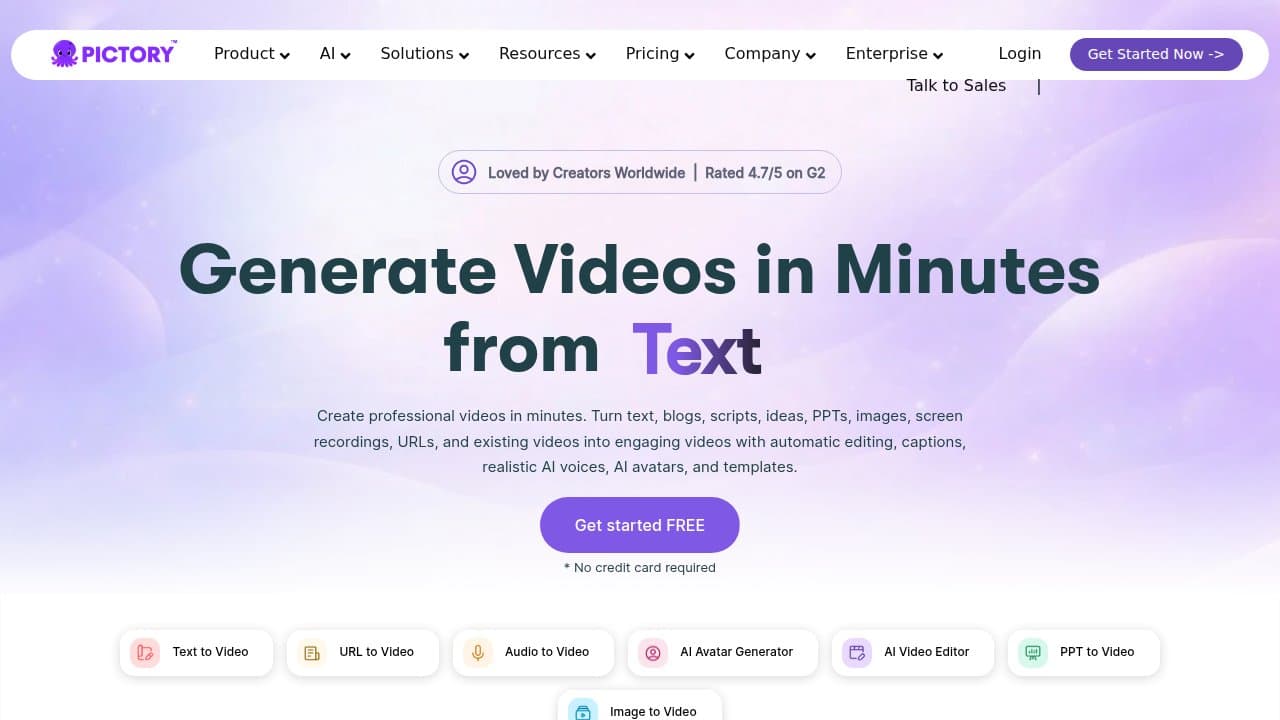

Pictory converts written content, blog posts, scripts, articles, and podcast audio, into social-ready videos using AI-matched stock footage and ElevenLabs voiceovers. A go-to for faceless YouTube creators and marketing teams repurposing long-form content at scale.
Pictory is a browser-based AI video creation platform built specifically for content repurposing. Founded in 2019 by Vikram Chalana (previously VP at Tableau and Microsoft), it converts existing written content, blog posts, scripts, articles, and podcast audio, into finished videos using automated scene selection, licensed stock footage from Getty Images and Storyblocks, and AI-generated voiceovers powered by ElevenLabs. You do not need video editing experience to use it. The platform handles scene pacing, caption generation, and stock media matching automatically. The March 2026 launch of Pictory 2.0 expanded the platform beyond text repurposing to include audio-to-video, PPT-to-video, and a prompt-based AI Studio that takes a raw concept and builds the full video pipeline end-to-end.
The core workflows are script-to-video (paste a script, get a video with matched stock clips), blog/article-to-video (input a URL or paste text), long-video-to-highlights (automated clip extraction from existing footage), and the newer audio-to-video mode for podcasters. A 14-day free trial with no credit card required covers up to 3 video projects. Paid plans start at $25 per month (billed annually) and unlock the ElevenLabs voice library, brand kits, and up to 18 million Getty and Storyblocks assets. The platform integrates with a Chrome extension for converting web articles directly, and a PowerPoint plugin released with Pictory 2.0. It has become one of the most promoted AI video tools by YouTubers and affiliate marketers, partly because of its tiered affiliate program paying 20 to 50 percent recurring commissions.
What Pictory outputs in April 2026
Pictory exports MP4 videos in up to 1080p resolution on Professional and Team plans (Starter is capped at 720p, and no plan currently offers 4K export). Videos include auto-synced captions, licensed background music from a library of 15,000 tracks, and AI voiceovers. The platform does not generate original video footage, all visuals come from a licensed stock library. Professional and Team subscribers access 18 million assets (Getty Images and Storyblocks); Starter subscribers get 5 million Storyblocks clips. After the Pictory 2.0 update, supported input formats include plain text, URLs, Word documents, audio files (MP3, WAV), video files (for highlights extraction), and PowerPoint files.
The AI Studio feature, added in March 2026, accepts a raw concept prompt and handles the full pipeline: writing the script, selecting visuals, generating voiceover, applying captions and branding. It is comparable to what Invideo's Co-pilot does, though Pictory's implementation currently produces more rigid output and less iterative refinement. Native voice cloning (recording your own voice to replicate across projects) and custom AI avatars built from user footage are listed on the product roadmap but were not yet available as of the Pictory 2.0 launch.
Where Pictory sits versus Invideo and Lumen5
Invideo takes a creation-first approach. You provide a concept or prompt, and Invideo's conversational Co-pilot adjusts the storyboard dynamically through natural language instructions: "Make this more upbeat" or "Add more shots of the product" produces immediate storyboard changes. Invideo includes a full timeline editor with layers, transitions, effects, and native voice cloning. Its stock library covers 16 million assets. Pictory's approach is repurposing-first: it ingests content you already have and automates the transformation. No timeline editor exists. The tradeoff is speed versus control. Pictory is faster for marketers with a finished script; Invideo is more flexible for creators who want to iterate creatively. Pictory's stock library (18 million Getty and Storyblocks assets) is meaningfully larger, which matters for footage variety. For teams that need both tools, many use Pictory for systematic blog-to-video repurposing and Invideo for original short-form content creation.
Lumen5 occupies similar territory but with a different stock infrastructure. Lumen5 draws primarily on Shutterstock's library (15 million standard assets, with access to a 160 million-asset Shutterstock marketplace on Business plans). Lumen5's storyboarding engine is stronger at identifying the "hook" of a long-form article, parsing visual hierarchy rather than doing a more literal keyword-to-footage match. It also offers 24/7 live customer support, which Pictory does not. However, Lumen5 lacks audio-to-video conversion, the ElevenLabs voice integration depth, and the AI Studio prompt-to-video workflow that Pictory introduced in 2.0. For brand-safe enterprise video where stock footage source matters (Shutterstock's extended licensing), Lumen5 has an advantage. For faceless YouTube channels and podcast repurposing, Pictory's feature set is more complete.
For avatar-based video where a realistic on-screen presenter is the core output, neither Pictory nor Lumen5 competes with Synthesia or HeyGen. Pictory's avatar feature is planned but unshipped. If realistic AI presenters are the primary requirement, those tools are built around it. Pictory's sweet spot is content that works without a human face: explainer videos, listicles, social clips, and educational summaries built from text.
"I've been an early adopter of Pictory.AI since 2021, and it's seriously become my go-to video sidekick." - verified user, Trustpilot, 2024
The real cost of generating video with Pictory
The Starter plan at $25 per month (annual) gives 200 video minutes per month. A typical 5-minute YouTube video therefore uses 2.5 percent of the monthly allotment. High-volume creators and agencies hit the ceiling fast. At 600 video minutes, Professional ($35/mo annual) is the plan most solo creators actually need, not Starter. The monthly billing rate for Professional is $59 per month, making the annual commitment a significant factor in real-world cost: monthly billing costs 69 percent more than annual for the same tier.
AI Credits (used by AI Studio and advanced AI features) are separate from video minutes. Starter gets 100 per month, Professional 500 to 1,000, and Team 2,400. ElevenLabs voice minutes are also capped per plan: 60 minutes on Starter, 120 on Professional, 240 on Team. Exceeding these caps requires upgrading or purchasing add-ons. The free trial allows 3 video projects with no credit card, which is useful for evaluating fit but not enough to stress-test the minute caps or voice quality at volume.
Pictory's affiliate program pays 20 to 50 percent recurring commissions depending on referral volume, which explains the high volume of affiliate-driven review content. Standard partners earn 20 percent per subscription. VIP partners (50+ referrals) earn 30 percent. Mega partners (250+ referrals) earn 40 percent with a free lifetime premium account. This structure has made Pictory one of the most promoted AI video tools by YouTubers, but also means a significant portion of online "reviews" are incentivized.
Where Pictory consistently breaks
Stock footage matching is the most documented weakness. Pictory's AI interprets scripts too literally: a video about email "open rates" may pull footage of people opening physical mail; "deliverability" may generate delivery truck clips. The Wyzowl review (Samantha Ferguson, December 2025) gave Pictory 3 out of 5 stars, describing the footage as "generic and incredibly literal: about as subtle as a brick." On one test, the phrase "Hi, this is Matt and welcome back to the channel" generated a "cheap-looking Christmas animation, for reasons unknown." Users can manually swap clips, but this defeats the speed advantage for creators who expected automation to handle scene selection accurately.
Download quality issues are a separate, persistent problem. Multiple Trustpilot reviewers from 2024 and 2025 report that downloaded videos contain random blank screen segments. One reviewer wrote: "I like the tool in general, but it glitches A LOT! Nearly half the time I create a video, when it is downloaded, it will have random blank screen throughout the video." Preview loading times are slow, with 30+ seconds reported for simple changes. When users report these issues to support, response times are slow and resolution is inconsistent. Pictory provides no 24/7 live support channel.
The AppSumo lifetime deal controversy is a separate trust signal. When Pictory ran its LTD campaign in 2022 (growing from 50 to 6,000 customers in two months), early buyers expected permanent access. By 2025, reports of account terminations were accumulating on AppSumo's review section. Lloydh, an AppSumo PLUS member and verified purchaser, wrote in October 2025: "My account had been deleted. No warning, no email, nothing." Pictory cited ToS violations, which buyers attributed to logging in from multiple countries while traveling. Whether or not the terminations were justified, the pattern damaged trust among early community members and signals that enterprise-style SLA expectations should not be assumed on lower tiers.
"My experience with Pictory has been absolutely frustrating. It could be a great platform if it weren't for the constant issues and the terrible support." - Trustpilot user, 2025
Best use cases versus skip-this scenarios
Pictory performs best for creators and teams with a steady output of written content to convert. A marketing team publishing 8-12 blog posts a month can systematically repurpose each into a LinkedIn or YouTube video in 20-30 minutes per post, without hiring a video editor. Faceless YouTube channel operators who write scripts around informational or affiliate topics find Pictory practical for high-volume publishing: several users report cutting per-video production time from 4 hours to under 1 hour. Podcasters using Pictory 2.0's audio-to-video mode can generate social distribution clips from episode audio without screen recording or editing. Course creators benefit from the PPT-to-video plugin for turning existing slide decks into narrated video lessons.
Skip Pictory if you need a timeline editor. There is no frame-level control, no layer system, no transition library, no color grading. For creators who care about precise visual pacing or brand-specific cinematography, Pictory produces a generic output that will require significant manual intervention in a separate editor, erasing the time savings. Skip it also if avatar-based video is the core requirement: until native avatar generation and voice cloning ship (roadmapped, not yet available), tools like Synthesia, HeyGen, or Fliki are better fits for presenter-style content. For pure text-to-video with a creative, iterative approach, Runway and Visla offer more creative control at higher price points.
Pictory is best understood as a content operations tool, not a creative tool. If you are already producing written content and want video versions without a video team, it is one of the most cost-effective ways to accomplish that at scale. If you are creating something new from scratch with cinematic or creative ambitions, it is the wrong starting point.
User Reviews
No reviews yet. Be the first to share your experience!
Sign in to write a review.
Related articles
Guides and articles related to Pictory.
Faceless YouTube AI Channel: $5,000+/Month Tutorial (2026)

AI Instagram Reels Factory: 30 Reels/Day on Autopilot (2026)
Sell AI-Generated Short Films on TikTok Shop, Instagram & YouTube (2026)
AI Video Generator Prompting: The Filmmaker's Real Workflow

How to Repurpose One Blog Post Into 30 Pieces With AI (The Step-by-Step System)