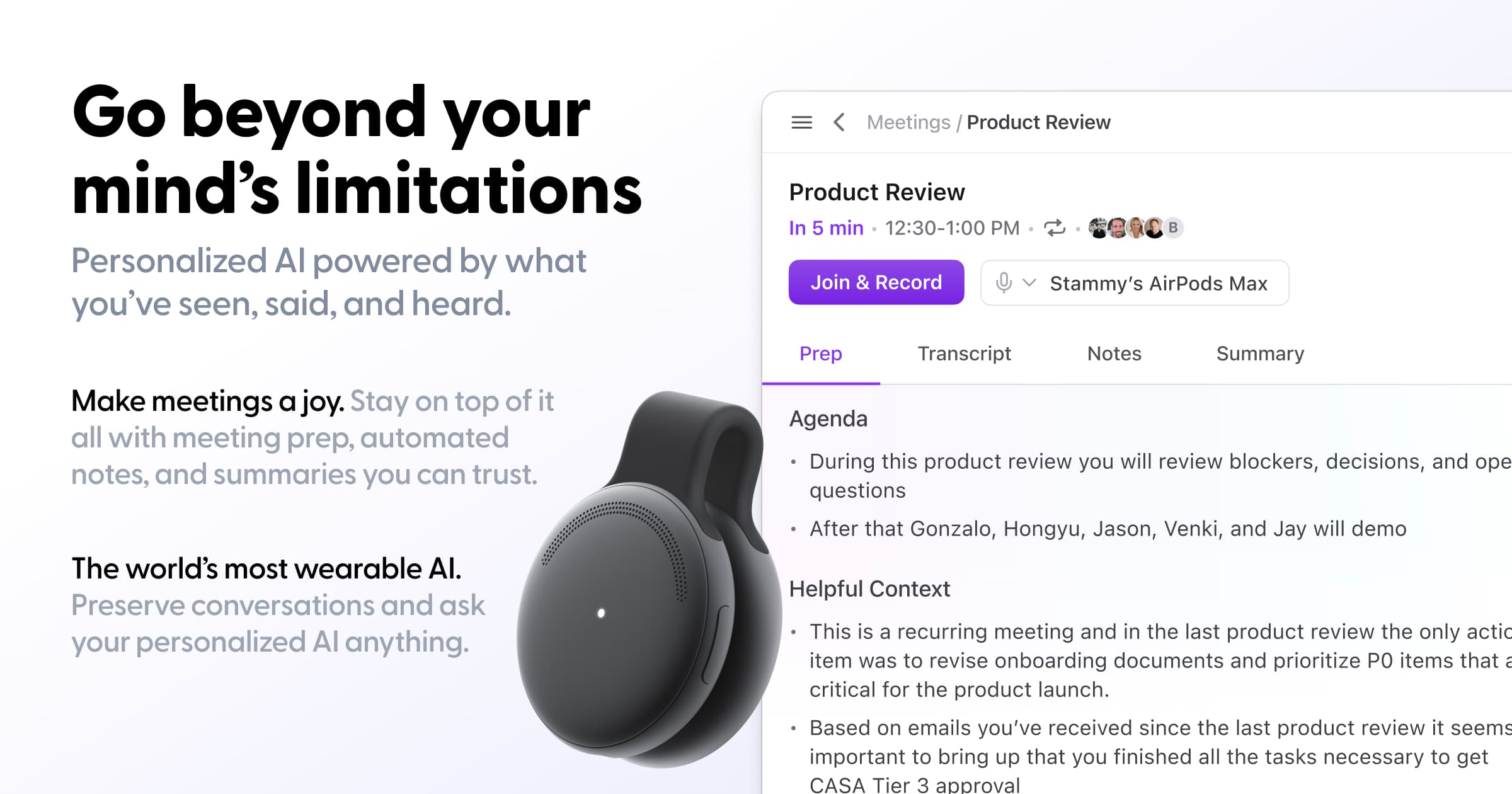

Limitless is a wearable AI pendant and meeting intelligence app built by Dan Siroker. It clips to your shirt, records in-person and virtual conversations continuously, and surfaces searchable transcripts, summaries, and action items.
Limitless is a wearable AI pendant and cross-platform meeting intelligence app founded by Dan Siroker, co-founder and former CEO of Optimizely, and Brett Bejcek. The company started in 2020 as Rewind, a Mac-only tool that recorded your entire screen, audio, and keyboard activity into a searchable personal archive. In April 2024, the company rebranded to "Limitless" and pivoted to a hardware-first strategy, shipping a physical pendant alongside apps for Mac, Windows, iOS, and Android. In December 2025, Meta acquired Limitless and the full team joined Meta's Reality Labs wearables organization, ending new Pendant sales. Existing users were moved to a free Unlimited plan, and the product continues to operate in maintenance mode as of May 2026.
The Pendant clips to a shirt or hangs from a lanyard and records in-person conversation continuously using an array of beamforming microphones, a waterproof housing, and a battery rated for around 100 hours between charges. The desktop app runs in the background on Mac or Windows, capturing system audio from Zoom, Teams, or Google Meet without requiring a meeting bot. Transcripts sync across devices, with the AI identifying speakers and flagging action items and key decisions. The app supported 103 languages on the Pendant and 34 languages in the mobile app, real-time meeting summaries, a conversational search interface for past conversations, and a developer API for building custom automations.
What Limitless actually is in 2024-2026
Limitless positioned itself at the intersection of two categories that rarely overlapped: hardware wearables (a pendant, not a phone case or wristband) and professional meeting intelligence software (transcription, summaries, action items). Most AI meeting tools operate as software bots you invite to a Zoom call. Limitless captured what those bots cannot: in-person conversations, hallway discussions, client lunches, and walk-and-talk planning sessions. The Pendant's beamforming microphone array was tuned to separate voices in noisy environments, making it genuinely useful for the kinds of conversations that never make it onto a calendar.
The platform integrated both capture modes into a single timeline. A morning standup on Google Meet and an afternoon whiteboard session were both searchable in the same app, tagged with participants and timestamps. The AI layer surfaced summaries through a chat interface: you could ask "what did we decide about the Q3 budget last Thursday?" and get a timestamped answer with a transcript link. For knowledge workers moving between digital and physical meetings all day, this unified capture was the clearest value proposition in the category.
The April 15, 2024 rebrand announcement became a significant moment for the wearable AI category. Within 24 hours of Dan Siroker's post, Limitless received more than 10,000 pendant pre-orders at $99. The announcement was framed as a direct contrast to the Humane AI Pin, which launched around the same time at $699 and was being panned by reviewers. One technology newsletter called the Limitless approach "a more useful version of Humane Ai Pin, at 1/7 the price." The contrast landed, and Limitless shipped its first hardware batch in late 2024, backed by $33 million in funding from Andreessen Horowitz, First Round Capital, NEA, and Sam Altman.
"Confidential Cloud might sound like an oxymoron, but it isn't. It is private by design." - Dan Siroker, CEO, TechCrunch, April 2024
Where Limitless sits versus Plaud Note and Bee AI
The wearable AI notetaker category had three meaningful products by mid-2025: Limitless, Plaud Note, and Bee AI. All three record audio and produce transcripts, but the mechanics differ substantially.
Plaud Note is a handheld device, not a wearable. It mounts as a phone case or attaches magnetically to a card holder. Recording is session-based: you press a physical button to start and stop. This makes it more intentional and less ambient than Limitless, which is better suited to professional environments where you want discrete, bounded recordings rather than a continuous lifelog. Plaud also records phone call audio directly through the phone-case hardware, something Limitless could not do. Plaud remains commercially available for new buyers as of 2026, priced at $159, and is the more practical choice for anyone entering the category today. Its app supports 34 languages but lacks the speaker diarization quality that Limitless offered at its best.
Bee AI took a wristband-first approach. The Bee Pioneer is a modular core (roughly 3 cm by 1.5 cm) that fits into a wrist clip or clip-on form factor, rated to 160 hours of battery life versus Limitless's 100. Bee does no onboard processing; it streams audio data to a paired smartphone. This makes the hardware lighter but means Bluetooth connectivity is a hard dependency. Bee's focus leaned toward personal journaling and conversational memory rather than professional meeting intelligence, and it did not emphasize speaker diarization to the degree Limitless did. Bee was acquired by Amazon in July 2025, so it too is in an uncertain state for new buyers seeking an independent product.
The mechanical summary: Limitless had the best speaker separation and the most mature meeting-intelligence layer of the three. Plaud Note wins on availability and discretion. Bee wins on battery life and physical lightness. If you are evaluating this category in 2026, Plaud Note is the only one still shipping to new customers without acquisition uncertainty hanging over it.
"Once the pendant is around your neck, it's easy to forget it's there." - Jason, via winstonfrancois.com, 2025
How AI actually works inside Limitless
Limitless ran a "Confidential Cloud" architecture that processed audio with end-to-end encryption before it reached the AI summary layer. Speaker diarization separated voices in multi-speaker recordings, assigning names to speakers you had labeled previously. After each meeting, the app generated a structured summary with detected action items, questions, and key decisions. A chat interface let you query the full transcript archive in natural language.
The desktop app ran as a background process on Mac and Windows, capturing system audio from any video call tool without needing a meeting bot. This was a notable advantage over competitors like Otter.ai and Granola, which either required bot invites or explicit integrations. For users on Zoom and Teams, Limitless captured the audio invisibly at the OS level.
The developer API exposed endpoints for transcript retrieval, summary generation, and conversation search. Power users built Make.com and Zapier automations to extract tasks into project managers, trigger journaling prompts, and push meeting summaries into Notion. The API was functional but had documented reliability issues: timeout errors during sync, inconsistent metadata on longer recordings, and latency spikes that made real-time integrations difficult. The more common path was treating Limitless as a passive archive and querying it manually through the chat interface.
The friction and reliability concerns users kept raising
Limitless had genuine value, but it also accumulated a distinct set of user complaints across its lifespan.
Hardware delivery delays. Some pre-orders placed in April 2024 were not fulfilled until late 2024 or not at all. A subset of backers received refunds and data exports rather than hardware. One Medium post from December 2025 summarized the experience bluntly: the author received "a refund, a zip file of my data, and a raised eyebrow" instead of the pendant they paid for.
Generic AI summaries. The daily summary feature, one of the product's headline promises, generated output that many users found unhelpful. Rather than surfacing professional insights, the AI offered wellness prompts such as "Don't forget to take care of yourself!" and suggested incorporating "a gratitude moment." Reviewer Damian Reilly tested it at length and concluded it was "an awful and life-negating device" that produced summaries disconnected from actual work content.
Unreliable speaker diarization. Mixing up speakers in multi-person conversations was a consistent complaint. The feature worked well in two-person calls but degraded in group meetings with similar-sounding voices or noisy environments.
API reliability. Users building custom automations reported timeout errors and sync failures. The API worked for batch retrieval but was not stable enough for real-time workflow integrations.
Privacy optics. The Pendant's recording indicator LED glows continuously while active and faces outward. There is no way to hide it. In professional client settings, several users reported discomfort from colleagues and clients who noticed the recording light.
Regional account deletion post-acquisition. EU, UK, Brazil, China, Israel, South Korea, and Turkey users had accounts forcibly terminated by December 19, 2025. No grace period, no option to migrate to a free tier.
Who Limitless is for, and when to look elsewhere
At its operational peak, Limitless made the most sense for a specific professional profile: knowledge workers in the United States who attended a high volume of both digital and in-person meetings, wanted unified transcript search across both contexts, and were comfortable wearing a recording device visibly. Early tech adopters and product managers who relied on conversation recall rather than manual note-taking got genuine value from it.
For meeting transcription without hardware, Granola and Krisp cover the digital meeting use case at lower friction. For noise cancellation in calls, Krisp does not require any hardware at all. For in-person recording that is still purchasable and maintained in 2026, Plaud Note is the direct successor to consider.
Skip Limitless if you are a new buyer in 2026: the pendant is no longer sold. Skip it if you are in the EU, UK, or any of the other regions where Meta terminated accounts at acquisition. Skip it if you wanted an ambient AI that captures video, screen activity, or anything beyond audio: the desktop screen-recording layer from the original Rewind product was sunset in December 2025. Skip it if you need a commercial integration with a maintained SLA; the product is in support-only mode, not active development.
The Limitless story is ultimately the clearest proof-of-concept for wearable AI meeting intelligence that the category has produced so far. The hardware design was thoughtful, the unified digital-plus-physical capture was genuinely differentiated, and the April 2024 rebrand announcement showed the market that a $99 wearable AI device could generate 10,000 pre-orders overnight. That the product ended up as a talent acquisition by Meta rather than a standalone business reflects the economics of hardware AI startups in 2024-2025 more than the quality of the core idea.
User Reviews
No reviews yet. Be the first to share your experience!
Sign in to write a review.
Related articles
Guides and articles related to Limitless Pendant.

The Personal AI Productivity Stack (2026): One Tool Per Job, Nothing Extra
Build a 70-Language Live Voice Agent With GPT-Realtime-Translate (2026)
Turn Any AI Agent Into a Superagent: The 12-Integration Stack (2026)
NotebookLM Sales Call Prep: 5 Sources, 6 Questions, 60 Seconds (2026)

Replit Pricing Explained (2026): Core vs Pro and Effort-Based Agent Billing