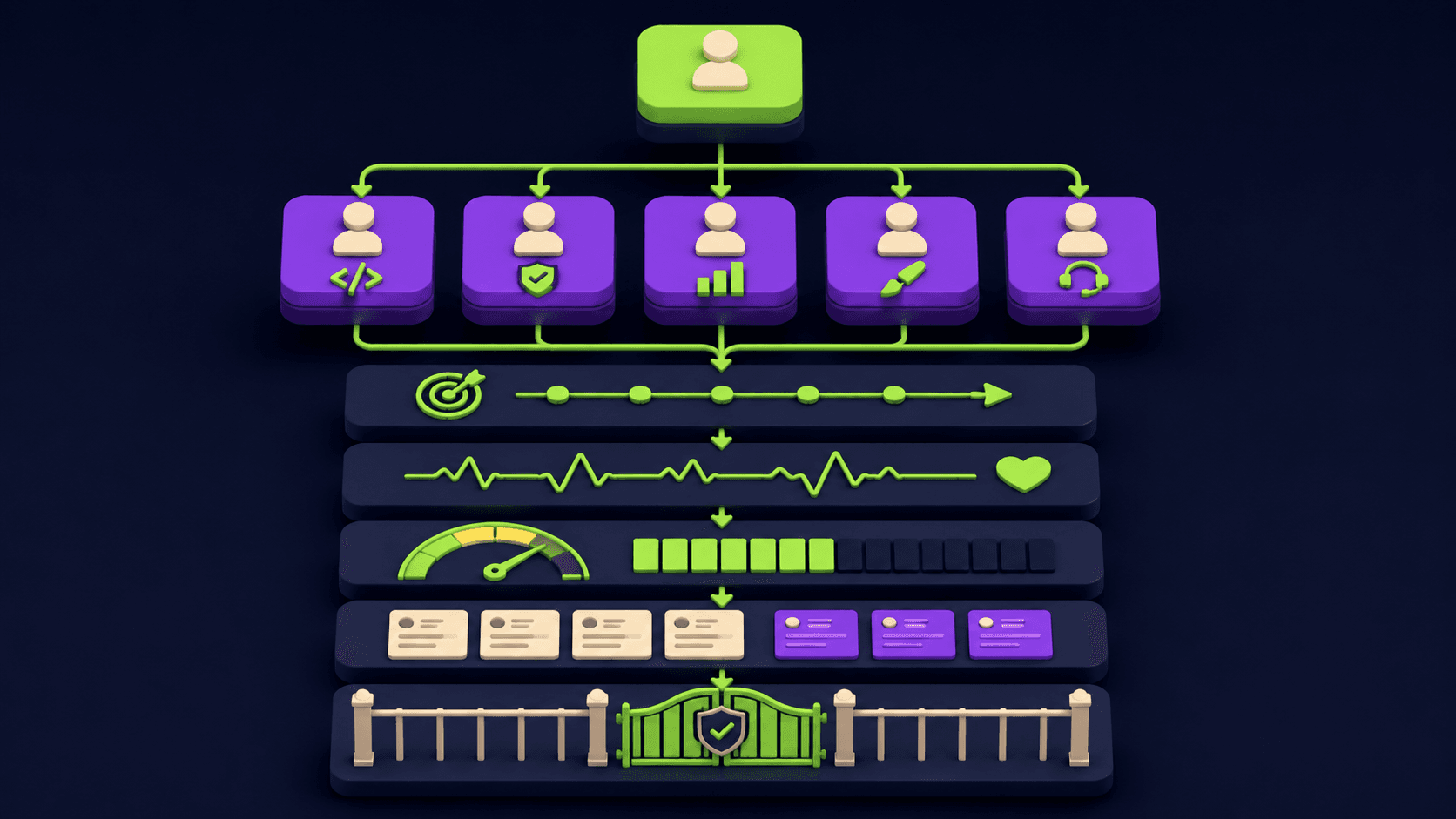

Reflection AI is a frontier AI lab built by ex-DeepMind researchers behind AlphaGo and Gemini. Its Asimov agent reads entire codebases, docs, and Slack threads to answer why software works the way it does, targeting large engineering organizations.
Reflection AI is a frontier AI research lab founded in March 2024 by Misha Laskin and Ioannis Antonoglou, two former Google DeepMind researchers who helped build Gemini and AlphaGo respectively. The company is pursuing two parallel goals: Asimov, a code comprehension agent for enterprise engineering teams, and a frontier open-weight language model intended to position the US as a counterweight to DeepSeek and closed labs like OpenAI and Anthropic. The lab launched from stealth in March 2025 with $130 million in funding from Sequoia, Lightspeed, CRV, and Nvidia, then raised a further $2 billion in October 2025 at an $8 billion valuation, bringing Nvidia, DST, Eric Schmidt, and Zoom CEO Eric Yuan into the cap table.
Asimov, launched publicly on July 16, 2025, is not a code generator. It is a code research and comprehension agent built to answer the question that Cursor and GitHub Copilot do not address: not "write me new code," but "explain why this existing system works the way it does." The agent ingests a company's entire engineering knowledge base, including codebase, architecture docs, GitHub threads, Jira tickets, Slack and Teams conversations, and email threads, then uses a multi-agent retriever-plus-combiner architecture to synthesize coherent answers. The frontier open-weight model, trained on tens of trillions of tokens using a Mixture-of-Experts architecture, is expected to be released for public download once training completes; as of May 2026, it has not shipped. Enterprise pricing runs $15,000-$25,000 per user annually, with a free waitlist beta that, as of early 2026, is still pending a functional signup flow.
Reflection AI at a glance, May 2026
Reflection's product lineup as of May 2026 consists of one shipping agent and one forthcoming model:
Asimov: Enterprise code comprehension agent. Multi-agent architecture (retriever agents plus a combiner reasoning agent). Reads codebases, docs, git history, Jira, Slack/Teams, and email. Powered by third-party models currently; proprietary models in training. Enterprise-only pricing. Waitlist beta exists but signup is currently non-functional.
Reflection Frontier Model: Open-weight large language model trained on tens of trillions of tokens, Mixture-of-Experts architecture. Designed to compete with Llama and Mistral at frontier scale. Weights to be publicly released. Not yet shipped as of May 2026.
The founding team's credentials are unusually strong. Laskin led reward modelling for Gemini at DeepMind. Antonoglou co-created AlphaGo, AlphaZero, and MuZero, the reinforcement learning breakthroughs that defined the modern AI era. The team of roughly 60 researchers and engineers has secured paying customers in financial services and technology, though the company has not disclosed customer names or counts.
"We've built something like Deep Research, but it's for your engineering systems.". Ioannis Antonoglou, CTO, Reflection AI, SiliconANGLE, July 2025
What Reflection AI is actually good at
Asimov's core strength is something no other mainstream coding tool addresses directly: institutional memory. Large engineering organizations accumulate knowledge across years of git commits, Jira tickets, architecture decision records, Slack threads, and emails. When engineers leave or teams grow, that knowledge evaporates. Asimov is designed to prevent that loss.
In blind testing with maintainers of large open-source projects conducted by Reflection, developers preferred Asimov's answers over those from Cursor Ask in a majority of cases, and over Anthropic's Claude Code (Sonnet 4) in 82% of cases. The specific use case tested was explaining how and why existing software behaves the way it does, not generating new code. That framing matters. Asimov is winning on a benchmark designed for its specific strength: code comprehension, not code generation.
The "Asimov Memories" feature allows team members to submit knowledge updates via natural language ("@asimov remember X works this way because of Y"). Role-based access controls let organizations manage what context different engineers can query. This makes Asimov behave less like a search engine and more like an engineering knowledge graph that updates continuously.
On the model side, Reflection's reinforcement learning expertise is a genuine differentiator. Antonoglou's work on AlphaGo demonstrated that RL-trained systems can outperform human experts on constrained domains. Applying those techniques to code (where correctness can be verified automatically) is a plausible path to models that self-improve on coding tasks in ways purely supervised models cannot.
Where Reflection AI breaks: the failure modes users keep hitting
The clearest friction is access. As of May 2026, the Asimov waitlist signup routes users to a blog post rather than a functional form. This is not a minor UX bug; it signals that organizational attention has shifted away from Asimov toward the frontier model effort. Engineers who heard about Asimov via the July 2025 launch and tried to sign up months later found a dead end.
Privacy is the second major barrier. Asimov's comprehension capability requires reading Slack messages, emails, and internal communications. Enterprise legal and security teams at regulated institutions need extensive review before approving this kind of access. Several industry commentators flagged this immediately after launch.
MIT computer science professor Daniel Jackson called Asimov "promising" but "unproven," specifically raising concerns about reading "private messages" between developers, a point that resonates differently in enterprise contexts where developer communications may reference unreleased products, M&A activity, or personnel decisions.
The benchmark transparency problem is also real. Reflection's 82% preference claim comes from Reflection's own testing, not an independent evaluation against standardized benchmarks like SWE-bench Verified. No third-party numbers have been published. For buyers making $15,000-per-seat decisions, self-reported benchmarks are insufficient.
Finally, the company's identity pivot creates confusion. Reflection launched as an autonomous coding company. It is now primarily describing itself as a frontier AI lab and open-weight model provider. Asimov, the only shipped product, is receiving less prominent placement on the website. Buyers evaluating Asimov must weigh whether the product will continue to receive development attention as Reflection's primary focus shifts to training frontier models.
"The company raised $2 billion but where the results? Reflection is executing the slowest path in the game while closed labs keep shipping.". Ksenia Se, Turing Post, March 2026
Reflection AI vs. Anthropic vs. Mistral
These three companies are the most commonly cited when discussing frontier model ambitions and AI coding capabilities, but they operate on meaningfully different architectures and timelines.
Anthropic is the closest direct reference point for Asimov's code comprehension benchmark claims. Claude 4 Opus scored 80.9% on SWE-bench Verified, the highest of any published model as of mid-2025. Claude Code runs across terminal, VS Code, JetBrains, a desktop app, and a web IDE, with a 200K token context window for holding large codebases in working memory. Claude Code's revenue run-rate reportedly surpassed $2.5 billion by late 2025. The critical mechanical difference: Anthropic is a closed-weights lab with a complete product ecosystem; Reflection has one enterprise-beta agent and a model in training. Asimov's 82% preference claim is specifically against Claude Code running Sonnet 4, not Opus, a meaningful distinction.
Mistral AI is Reflection's closest philosophical analog. Both are positioning as open-weight frontier labs challenging closed AI incumbents. But Mistral has actually shipped: Mistral Large, Mixtral 8x7B (MoE architecture, publicly available), Mistral 7B (Apache 2.0), and Codestral specifically for code generation. Mistral targets European AI sovereignty (GDPR-compliant, Paris-based); Reflection targets US and Western sovereignty. Mistral's weights are downloadable today; Reflection's are in training. On the coding side, Mistral's Codestral competes in code generation; Reflection's Asimov targets code comprehension, making them less directly competitive than the frontier model positioning suggests.
Users often pair code comprehension agents like Asimov with generation tools like Cursor or Devin for a full workflow: Asimov explains what exists; Cursor or Devin writes what's new. That pairing is explicitly how Reflection frames Asimov's role, though it raises the question of whether the comprehension-only positioning is a permanent strategy or a beachhead.
Is the paid tier worth it?
At $15,000-$25,000 per user annually, Asimov is priced like enterprise software, not like an individual developer tool. For context, Cursor's Business plan is $40 per user per month. Asimov is roughly 30-50x more expensive per seat.
The ROI case Reflection makes is compelling in theory: if a senior engineer onboards 50% faster onto a 500,000-line codebase, or if a platform team can migrate a critical service without losing institutional context when the original engineers have left, the value can justify the price at scale. Financial services firms and large technology companies with codebases measured in millions of lines have the most credible use case.
For teams below 50-100 engineers, the economics are harder to justify. The product requires dedicated integration work, legal review for data access permissions, and ongoing maintenance of the knowledge graph. Smaller teams are better served by Cursor, Claude Code, or similar tools that do not require enterprise procurement cycles.
The frontier model, once released, will likely be freely downloadable as open weights. That makes it more relevant to research teams and organizations wanting to self-host than to developers looking for a managed API. Users planning to run their own inference should compare Reflection's MoE model directly to Llama 3 and Mistral when weights are available.
Best use cases (and when to skip it)
Asimov is worth evaluating for engineering organizations that:
Manage codebases older than five years with high staff turnover
Regularly onboard engineers onto complex, underdocumented systems
Have experienced knowledge loss when senior engineers depart
Operate in regulated industries requiring on-premise or private cloud deployment (where the frontier open-weight model is particularly relevant)
Have legal and security teams that can approve reading internal communications as an AI data source
Skip Asimov when:
Your team is fewer than 20 engineers. The per-seat cost is prohibitive relative to alternatives.
You need a code generator, not a code explainer. Asimov does not write new code; it explains existing code.
You need access right now. As of May 2026, the waitlist is non-functional and enterprise procurement is the only path to access.
You need independent benchmark validation before committing budget. Reflection's performance claims are self-reported.
The frontier open-weight model is worth monitoring for AI researchers, government agencies, and enterprises building sovereign AI systems who want a Western alternative to both closed labs and DeepSeek. Once released, compare it against Llama and Mistral on coding and reasoning benchmarks before committing to deployment infrastructure.
Getting started with Reflection AI
The practical entry point as of May 2026 is to contact Reflection directly via the sales inquiry form at reflection.ai. The waitlist at tryasimov.reflection.ai is present but routes to a blog post rather than an active signup. Documentation for Asimov is available at docs.reflection.ai and covers integration setup, the retriever architecture, and the Asimov Memories system for team knowledge management.
For the frontier open-weight model, Reflection's blog at reflection.ai/blog covers their training approach, MoE architecture plans, and open-weight commitment. Watch the company's X account (@reflection_ai) and Misha Laskin's personal account (@MishaLaskin) for model release announcements, as these have been the primary communication channels. Hugging Face will be the distribution point for model weights when they release.
User Reviews
No reviews yet. Be the first to share your experience!
Sign in to write a review.
Related articles
Guides and articles related to Reflection AI.
Grok 4.3 API for Agents (May 2026): Pricing, Benchmarks, Migration
Turn Any AI Agent Into a Superagent: The 12-Integration Stack (2026)
Replit Pricing Explained (2026): Core vs Pro and Effort-Based Agent Billing
Coding Ate Enterprise AI (2026): The $4B Use Case, Anthropic’s Share, and Seat vs API Math
AI User Testing in 2026: The Tools That Test Your Product While You Sleep