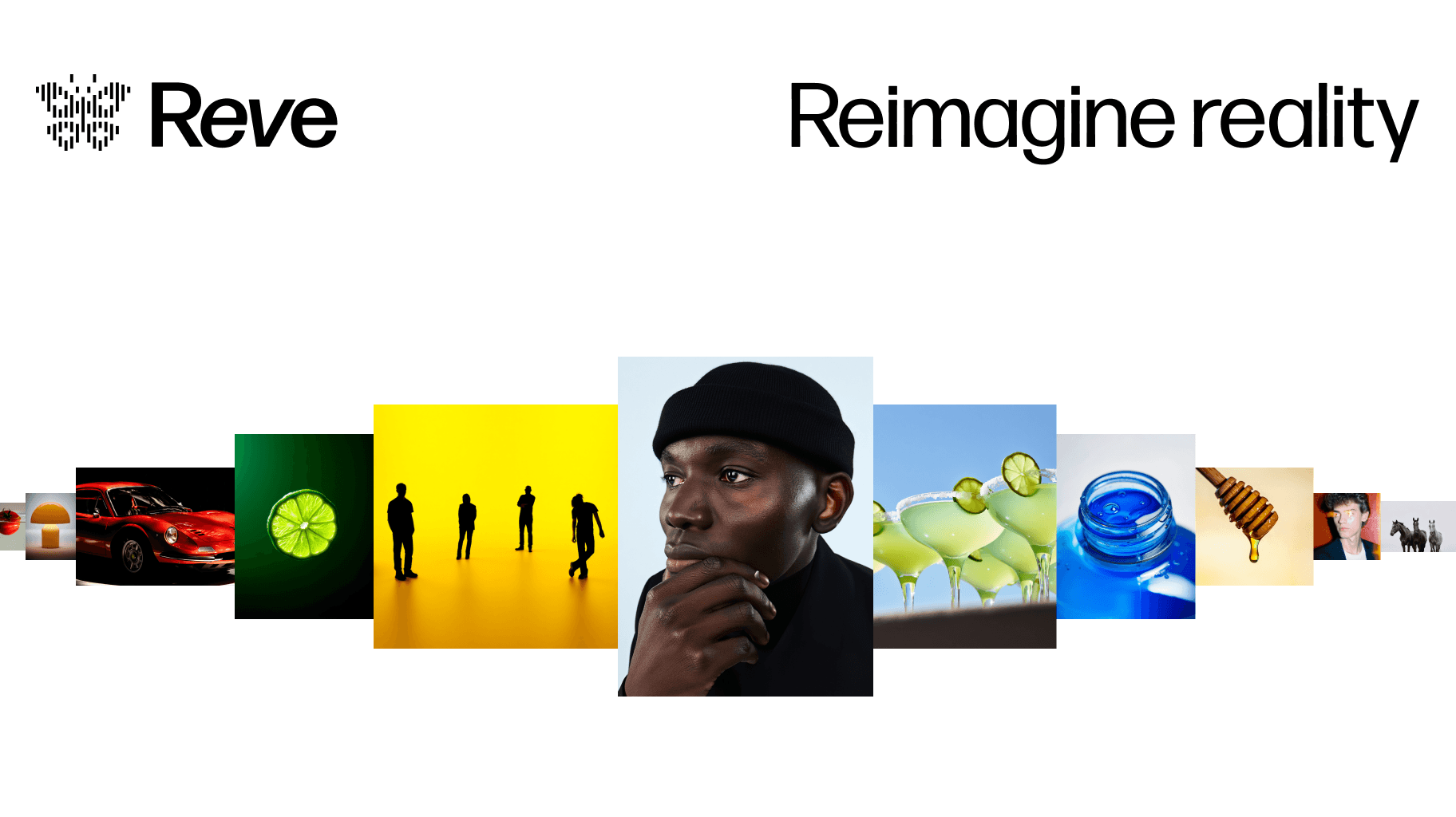

Reve Image launched as "Halfmoon" in March 2025 and immediately topped the Artificial Analysis Image Arena leaderboard. Built by ex-Adobe researchers, it excels at prompt accuracy and text rendering at a fraction of Midjourney's cost.
Reve Image is a text-to-image and image editing AI built by Reve AI, Inc., a California startup founded by three former Adobe and Stability AI researchers: Michaël Gharbi, Taesung Park, and Christian Cantrell. The tool launched publicly on March 24, 2025, after quietly running anonymously under the codename "Halfmoon" on the Artificial Analysis Image Arena, where it accumulated an ELO of 1167 and claimed the #1 position globally, overtaking Recraft V3, Google Imagen 3, FLUX, and Midjourney v6.1 across more than 40 competing models. The model was trained from the ground up, not fine-tuned from an existing base, with a 12-billion-parameter hybrid architecture combining multimodal and parallel diffusion transformer blocks. Reve's stated engineering priorities are prompt adherence, typography rendering, and aesthetic quality, and independent testing consistently bears those out.
The current product (May 2026) centers on three modes: text-to-image generation using the v1.0 model, instruction-based image editing where natural language commands modify an existing image, and the Reve v1.5 Preview model released in late February 2026 that outputs native 4K resolution with improved photorealism and sharper textures. The API at api.reve.com gives developers direct access at $0.024 per text-to-image generation and $0.04 per remix or edit. Free accounts receive daily generation credits with full commercial rights included, an unusually generous policy compared to tools like Recraft, which watermarks free outputs. For a tool that spent its first week anonymous on a leaderboard, Reve is now a real contender in a crowded category.
What Reve Image generates in May 2026
Reve v1.0 handles text-to-image generation from natural language prompts, instruction-based editing of uploaded or previously generated images, and style reference uploads where you provide a reference image and describe variations. Generation speed typically runs under 20-30 seconds. The base model outputs at up to 2048x2048, with optional upscaling to 4K. The newer v1.5 Preview model, announced via the official Reve X account in early 2026, generates natively at 4K (4096x4096) with meaningfully improved photorealism and texture sharpness, though as of this writing it is text-to-image only. Reference image inputs and editing on v1.5 are roadmapped but not yet live.
The model's defining capability, the one that made the Halfmoon reveal a headline, is its typography engine. Where Midjourney consistently distorts, misspells, or renders text illegibly, and where FLUX occasionally misses words in complex layouts, Reve generates clean, readable text inside images with accuracy that makes it the default choice for logo treatments, neon signage, product labels, and branded mockups. Reviewers at Curious Refuge Labs scored its prompt adherence at 9.5 out of 10 and called it "one of the most obedient models we've ever tested." That obedience extends to composition, spatial relationships, and multi-element scene construction, not just typography.
The editing layer, launched as a dedicated model in October 2025, allows direct region targeting for precise adjustments. You can type "remove the shadow on the left side" or "change the jacket from black to forest green" and the model applies edits that respect the rest of the image. Reve compares this to what GPT Image 2 and DALL-E 3 offer through conversational refinement, though Reve's approach integrates the canvas and editing interface in a single web view rather than requiring back-and-forth in a chat window.
Where Reve Image sits versus Midjourney and FLUX
Reve Image vs. Midjourney: Midjourney's 12-year head start in community building shows in its aesthetic vocabulary. The platform has a proprietary model with a recognizable house style: high contrast, cinematic saturation, and what regular users call its "magic" quality for stylized art. More critically, it offers granular creative controls that Reve simply does not have: --stylize (0-1000 scale), --chaos, --weird, --sref (style reference seeds), and --cref (character reference). A Midjourney power user with 20,000 generations has a toolkit Reve cannot replicate. Where Reve wins consistently: prompt adherence, typography, portrait diversity, and photorealistic skin rendering. Where Midjourney wins: stylized output, mood and atmosphere, and the creative variance that comes from a larger parameter space of aesthetic controls. Eric Kerr, a self-described Midjourney power user, noted in a March 2025 review that Reve delivered output that was "fast, polished, and commercial-ready," while conceding that Midjourney's granular style control was still unmatched for creative experimentation.
"While Reve doesn't offer Midjourney's granular control over style and weirdness levels, what it delivered was far from disappointing." - Eric Kerr, Medium, March 26, 2025
Reve Image vs. FLUX.1: FLUX.1 from Black Forest Labs uses a dual-stream diffusion transformer architecture, with 19 double-stream transformer blocks processing image and text tokens in parallel streams before merging. The key mechanical difference is that FLUX.1 [dev] and FLUX.1 [schnell] are released as open weights under non-commercial and Apache 2.0 licenses respectively, meaning any developer can download, fine-tune, and self-host FLUX locally. Reve is a closed model with no public weights, so you cannot self-host it or fine-tune it for a specific visual domain. For teams that need LoRA training on proprietary image sets, or enterprise deployments that require on-premise processing, FLUX is the practical choice. On raw output quality for text rendering, Reve benchmarks higher. On fine-grained skin texture in portraits, FLUX produces smoother results. API pricing is comparable: FLUX.1 Pro runs around $0.055-0.065 per image on Replicate versus Reve's $0.024-0.040 range, making Reve meaningfully cheaper for scale.
"Congratulations to @reveimage on creating the world's leading image generation model with Reve Image! Reve Image has been in the Artificial Analysis Image Arena over the past week and is the clear leader, beating strong competition including Recraft V3.." - @ArtificialAnlys (Artificial Analysis), X, March 24, 2025
For context against other tools: Google Imagen 3 targets enterprise buyers through Vertex AI, with pricing and access structured around Google Cloud accounts rather than self-serve credits. Imagen 3 ranked below Reve in the Artificial Analysis arena as of the March 2025 Halfmoon reveal. Reve undercuts it dramatically on accessibility and cost for teams not already inside the Google Cloud ecosystem.
Real cost of running Reve Image
The free tier is the most accessible entry point: Reve gives free accounts a daily credit allocation (called "energy") with no watermarks and full commercial rights on outputs. This is genuinely unusual. Most free tiers in this category either watermark outputs (Recraft), require a paid plan for commercial use, or heavily rate-limit in ways that make the free tier functionally useless for real projects.
The paid tiers as of 2026:
Free: Daily generation limit, introductory energy credits on signup, full commercial rights. No watermarks.
Lite: $7.99/mo, 5x more generation energy than Free, commercial rights included, standard queue priority.
Pro: $19.99/mo, 100x more generation energy than Free, priority queue, commercial rights. Best for high-volume creators.
API access is separate from subscription tiers and is priced per generation: $0.024 per text-to-image call and $0.040 per edit or remix. At launch in March 2025, API access was offered at $5 for 500 generations ($0.01/image), making it the cheapest commercial image API on the market. Pricing has adjusted since, but Reve remains substantially cheaper than FLUX Pro API ($0.055+/image) and far below Midjourney's subscription floor of $8/month for limited Discord access.
Commercial rights are included across all tiers, including the free plan. This matters for agencies and content studios that need clean IP provenance on deliverables.
Where Reve Image reliably fails
Reve has a clear failure profile that has stayed consistent across reviews from launch through mid-2026. Knowing these ahead of time saves time:
Complex physics and transparent materials: Reviewers and users repeatedly flag transparent objects (a full wine glass, a glass of water with ice, reflective surfaces), pouring liquids, and crowd scenes as weak spots. The model handles controlled-lighting studio scenes well; organic chaos and real-world physics are harder.
No inpainting or manual masking: Reve's editing system is instruction-based, not brush-based. If you need to fix a specific region without touching the rest of the image, you are working around a limitation. Traditional inpainting workflows require you to use a different tool. This is a significant gap for photo retouching and compositing work.
No granular style controls: There is no equivalent to Midjourney's --stylize, --chaos, or --weird parameters. If your prompt does not contain enough style specification, Reve will follow it literally. That is the point, but it means creative variance requires more explicit prompt writing rather than parameter-tuning.
No mobile app: Web-only, with no native iOS or Android application as of May 2026. The site is mobile-browser optimized, but the experience differs from a purpose-built app, and Midjourney's Discord mobile access gives it a portability advantage for creators who generate on the go.
v1.5 feature gap: The newer v1.5 model, released February 2026 with native 4K output, does not yet support image reference inputs or editing. If you want the higher resolution, you lose the editing workflow until Reve ships those features on v1.5.
Fictional characters and highly stylized renderings: Reviewers note that Reve struggles with intellectual property-adjacent content: fictional characters, stylized cartoon aesthetics, anime-style output. For photorealism and graphic design, it excels; for character art and illustration, results are inconsistent.
Who Reve Image is for, and who should pick something else
Reve Image is the right tool if you regularly create content that requires legible text inside images: logos, signage, product packaging mockups, social media graphics with typography, or any branded visual asset where Midjourney would embarrass you with a misspelled sign. It is also a strong choice for photorealistic portrait work with diverse subject representation, product photography stills in controlled scenes, and any team that needs commercial-grade outputs without paying Midjourney Pro rates.
Developers who want to build image generation into a product at low cost should look seriously at the Reve API. At $0.024 per generation with full commercial rights, it is one of the more competitive API pricing points available for a closed, production-ready model.
Skip Reve if your workflow depends on inpainting, outpainting, or manual masking tools. Those do not exist here in a meaningful way. Skip it if you need fine-tuned models trained on your own image corpus, since Reve offers no fine-tuning path. Skip it if you primarily create stylized or illustrated work rather than photorealistic output: Midjourney's aesthetic engine and its style parameter suite remain in a different league for that use case. And skip it if you are building on open infrastructure, since FLUX.1's open weights give you self-hosting, local inference, and LoRA fine-tuning that Reve simply cannot offer as a closed model.
For teams that have been using DALL-E 3 via the ChatGPT interface and want comparable quality with a faster iteration loop and cheaper API pricing, Reve is worth a serious evaluation. It is not a replacement for every use case, but for prompt-precise commercial design work, it is genuinely competitive with tools that charge three to four times as much.
User Reviews
No reviews yet. Be the first to share your experience!
Sign in to write a review.
Related articles
Guides and articles related to Reve Image.
AI Fashion Prompts That Stay Consistent: The Working Formula (2026)
Wix Logo Maker Review (2026): Real Costs, the Edit Catch, and AI Alternatives
Google Vision AI Explained (2026): Pricing Per 1,000 Units, Free Tier, and Alternatives
Freepik AI Is Now Magnific: What Changed, What It Costs, and Whether to Stay (2026)
Best AI Fashion Model Generators for Clothing Brands (2026)