Faceless YouTube AI Channel: $5,000+/Month Tutorial (2026)
How to Build an AI Faceless YouTube Channel That Earns $5,000+/Month (2026 Tutorial)
A faceless YouTube channel is a channel where no human appears on camera: voiceover, B-roll, AI avatars, screen recordings, or stock visuals carry the video. In 2026, AI tools collapsed the production cost from roughly 8 hours and $200 per video to under 30 minutes and under $3 per video, while finance and tech sub-niches still pay $12 to $35 RPM per the Outlierkit 2026 RPM data. The faceless channel BRIGHT SIDE earns an estimated $1.7M/year with 44.7M subscribers, per Social Blade. This tutorial is the step-by-step playbook to hit $5,000/month in 90 days using the same stack.
TL;DR
Faceless = voiceover plus AI visuals, no on-camera presenter
YPP needs 1,000 subs plus 4,000 watch hours OR 10M Shorts views
Finance niche RPM: $12 to $35 long-form, far above the $5.70 platform average
Full AI stack: under $80/month at startup
$5K/month target hits around 200K to 400K monthly views in a paid niche
What is a faceless YouTube channel and why are AI tools changing the math?
A faceless YouTube channel publishes long-form or short-form video without showing a human presenter on camera. AI tools matter because they collapsed the production stack: a script that took 4 hours now takes 20 minutes with Claude or GPT, a voiceover that cost $50 from a freelancer now costs $0.18 in ElevenLabs credits, and a 10-minute video that needed Adobe Premiere now assembles in CapCut or Pictory in under an hour.
The structural shift is unit economics. Per the aitooldiscovery.com 2026 AI side hustle guide, AI voice tools, automated video assembly, and multilingual dubbing have collapsed production costs to under $3 per video. The old faceless model required a $500/video freelancer team or 20 hours of self-edit labor; the AI model produces the same deliverable for less than the cost of a coffee.
Three numbers anchor the opportunity:
YouTube paid out $70B+ to creators across the last three years per the Loopex Digital 2026 Shorts statistics; faceless channels capture a meaningful slice of that.
The platform-wide average CPM was $5.70 in late 2024 per the Miraflow CPM data; finance, tech, and B2B sit 3x to 6x above that average.
YouTube clarified in 2026 that faceless and AI-assisted channels are NOT banned; only "low-effort, mass-produced" inauthentic content is targeted, per the Miraflow monetization policy brief. Channels with research, narrative direction, and human review remain fully monetizable.
The opportunity is the inversion of cost vs. revenue. Production cost dropped 90%+ in two years; ad RPMs in paid niches did not drop. Capture the spread and the unit economics work.
How much can you actually earn with an AI faceless channel? (real revenue data by niche)
Realistic faceless channel revenue spans $300/month at 50K monthly views in a low-paid niche to $20,000+/month at 1M monthly views in finance. The platform-wide RPM averages $1 to $5 for long-form ad revenue in 2026 per the Lenos 2026 CPM/RPM rates; high-RPM niches such as finance, tech, and B2B run 3x to 7x that.
Niche | Long-form RPM | Shorts RPM (per 1K) | Monthly revenue at 500K views | Source |
|---|---|---|---|---|
Personal finance / investing | $12 to $35 | $0.10 to $0.25 | $6,000 to $17,500 | |
Tech reviews / software | $8 to $20 | $0.05 to $0.15 | $4,000 to $10,000 | |
B2B / SaaS / marketing | $15 to $40 | $0.10 to $0.30 | $7,500 to $20,000 | |
Real estate | $10 to $30 | $0.08 to $0.20 | $5,000 to $15,000 | |
Health / wellness (non-medical) | $4 to $12 | $0.03 to $0.08 | $2,000 to $6,000 | |
History / education | $3 to $8 | $0.02 to $0.05 | $1,500 to $4,000 | |
True crime / mystery | $3 to $7 | $0.02 to $0.05 | $1,500 to $3,500 | |
Meditation / sleep | $1 to $4 | $0.01 to $0.03 | $500 to $2,000 | |
Gaming / entertainment | $1 to $3 | $0.01 to $0.03 | $500 to $1,500 |
Three reality-check notes on this table. First, the "monthly revenue at 500K views" column is ad revenue ONLY; affiliate, sponsorships, and product sales typically add 30% to 200% on top, per the patterns in r/passive_income discussions cited by aitooldiscovery.com. Second, real channel data: BRIGHT SIDE pulls roughly $1.7M/year on 44.7M subscribers (a low-RPM general-interest niche carried by sheer volume) per Social Blade; Jake Tran reportedly grosses about $250K/month across three faceless channels combining ads, sponsors, and memberships per a 2026 interview. Third, $5K/month is realistic in a paid niche at roughly 200K to 400K monthly views, NOT at the millions-of-views scale the headline channels operate at.
Which niches are still under-saturated for AI faceless in 2026?
Genuine under-saturation in 2026 sits in middle-ground niches: specific enough to escape the cash-cow flood, broad enough to have real search demand. Per the Outlierkit 2026 untapped niches study, the test is "fewer than 10,000 active channels with proven search demand and active monetization." Below are the eight categories that meet that bar today.
Niche | Why under-saturated | RPM tier | Format that works |
|---|---|---|---|
Micro-health (specific symptoms / quirks) | Dominated by face-cam doctors; faceless gap wide open | Mid ($4 to $12) | "Why your X does Y" explainers |
Stoicism applied to modern stress | Most stoicism content is generic quote compilations | Mid ($4 to $10) | "What [Marcus Aurelius] would say about [doomscrolling]" |
Plain-English tech explainers | Tech reviewers chase phones; nobody explains how things work | High ($8 to $20) | "How [Spotify recommendation] actually works in 4 minutes" |
Cause-and-effect history | Most history channels list dates; few explain WHY | Low-mid ($3 to $8) | "Why [WW1] really started, in 7 events" |
Local-economy explainers (US/UK/CA cities) | National finance is saturated; city-specific is empty | High ($10 to $30) | "Why [Austin] rent jumped 47% (the data)" |
Niche software workflows (one tool per channel) | SaaS spending is record-high; tutorial supply is thin | High ($12 to $25) | "How to [build X] in [Notion] in 8 minutes" |
Specific career paths (not generic "career advice") | "Career advice" is dead; "how to become a quant analyst" is open | High ($10 to $25) | Day-in-the-life + salary breakdown |
AI tool comparisons (per use case) | "Best AI tools 2026" listicles flooded; head-to-head benchmarks rare | High ($8 to $20) | "X vs Y for [specific use case], tested" |
The pattern across all eight: a question a real person types into Google, with fewer than 50 watchable answers. Per the Ryan Blake faceless niches breakdown, the ideal target shows steady search demand on TubeBuddy or vidIQ but fewer than 100 channels with over 10K subscribers competing on the topic. Run that filter through vidIQ or TubeBuddy before you commit a quarter to a niche.
What's the full AI tool stack? (script then voice then visuals then edit then SEO)
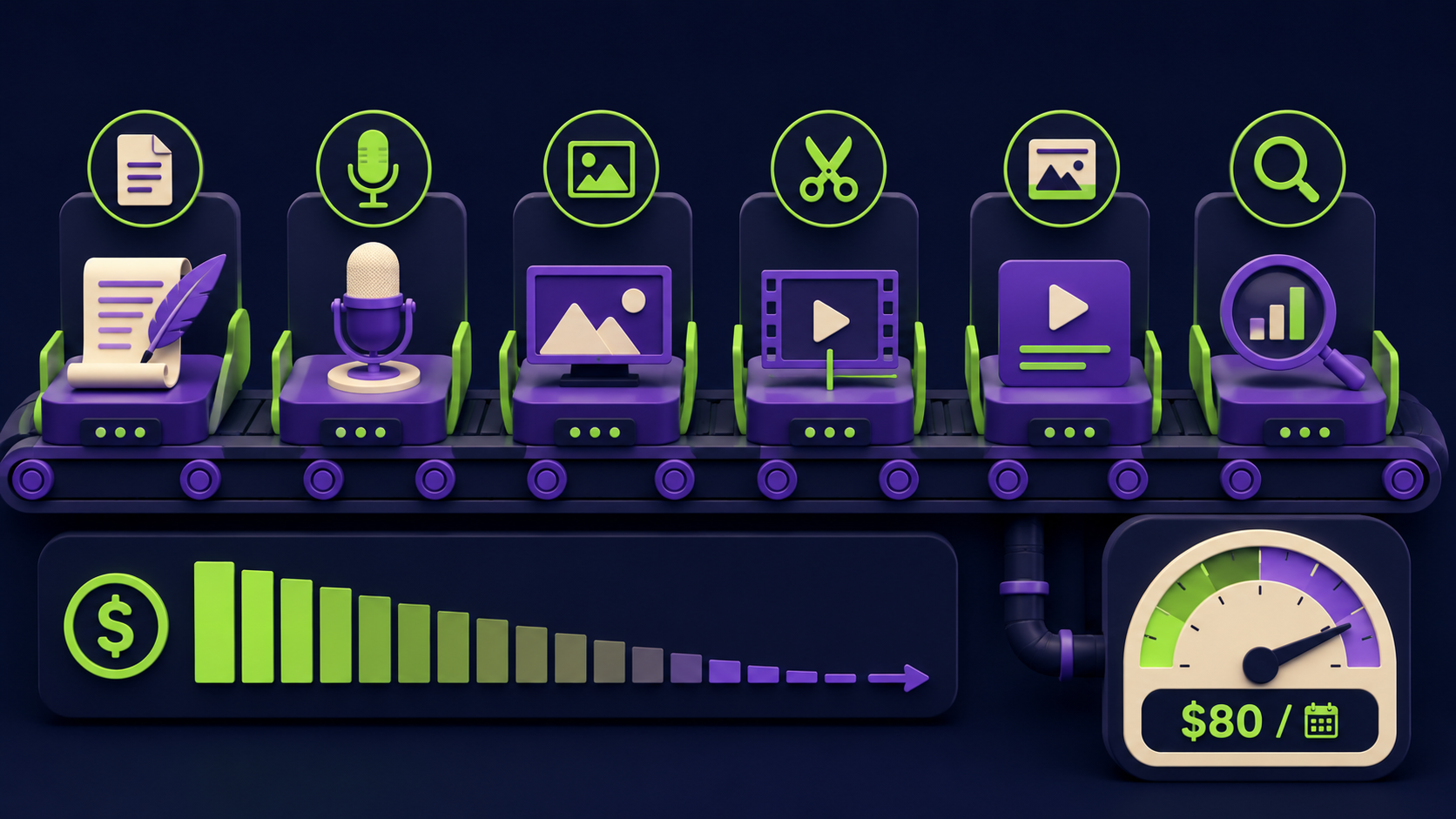
The complete AI faceless stack covers six steps: script generation, voice synthesis, visual generation, edit and captions, thumbnail, and SEO research. Total stack cost runs $0 (free tiers only) to $80/month at the realistic operating tier. You do NOT need every tool in every category to start; pick one per row.
Step | Tools | 2026 entry price | What it does |
|---|---|---|---|
1. Script writing | $0 to $20/mo | Hooks, beats, full scripts in your voice | |
2. Voice synthesis | $5 to $22/mo | Natural-sounding voiceover, voice cloning, commercial rights | |
3. Visuals (B-roll, scenes) | Pictory, Invideo AI, stock libraries | $15 to $29/mo | Auto-match B-roll to script, AI scene generation |
4. Edit + captions | $0 to $40/mo | Burn-in captions, multi-aspect export, virality scoring | |
5. Thumbnails | $10 to $30/mo | Photoreal hero images; Ideogram for thumbnails with text | |
6. SEO + research | $0 to $27/mo | Keyword research, A/B thumbnails, competitor metrics | |
7. Automation | $0 to $29/mo | Chain script-to-render-to-upload pipeline, Notion calendar | |
8. Calendar + ops | Notion, Airtable | $0 to $10/mo | Content calendar, video status board, idea backlog |
9. Hosting (n8n / dashboard) | $6 to $25/mo | Self-host n8n cheaper than the $24/mo cloud plan |
Pricing notes verified from official sources: ElevenLabs Starter is $5/mo with commercial rights and 30,000 characters per the ElevenLabs pricing page; Murf Creator is $19/mo annually with full commercial rights per Murf pricing; Submagic Starter is $20/mo for 30 captioned videos per Submagic pricing; Opus Clip Starter is $15/mo for 150 processing minutes per Opus Clip pricing; CapCut Pro is $7.99/mo monthly or $4.99/mo annual per the FluxNote CapCut pricing 2026; TubeBuddy Pro is $4.50/mo at the entry tier per TubeBuddy pricing; Pictory Starter is $19/mo per the Pictory pricing page.
A practical starting bundle: ChatGPT Plus ($20) + ElevenLabs Starter ($5) + Submagic Starter ($20) + CapCut Pro ($5 annual) + TubeBuddy Pro ($4.50) + Ideogram or Midjourney basic ($8 to $10) + Hostinger KVM 2 ($6 self-host n8n). Total: roughly $69/month. That's the operating budget for the first 90 days.
Step-by-step: how to publish your first AI faceless video in 4 hours
This walkthrough produces one 8-minute long-form video plus three repurposed Shorts in roughly 4 hours of focused work. Cost: under $4 in tool credits. Use this exact sequence for your first 5 videos before you start optimizing.
Pick the topic (15 minutes). Open vidIQ or TubeBuddy, search for 5 candidate keywords in your niche, filter for "search volume above 1,000/mo and competition below 50." Pick the keyword whose top 3 results have under 100K subscribers each. That's your topic.
Write the script (40 minutes). Open Claude or ChatGPT. Prompt: "Write an 8-minute YouTube script on [topic]. Hook = 8 seconds, pose a contrarian or surprising claim. Then 5 beats of 90 seconds each, each beat opens with a question and ends with a 1-line takeaway. Close with a 30-second CTA. Voice: conversational, second person, zero hype words." Edit the output for accuracy and your voice. Final length: roughly 1,400 words.
Generate the voiceover (15 minutes). Paste the script into ElevenLabs Speech Synthesis. Pick a voice from the library (try "Adam" or "Rachel" for general-purpose) or upload your own voice clone (Starter plan, $5/mo, includes commercial rights per the ElevenLabs pricing page). Set Stability 45, Similarity 75, Style 0. Render and download.
Build the visuals (90 minutes). Two paths. Path A (faster): drop the voiceover into Pictory or Invideo AI, let it auto-match stock B-roll to the script's keywords, manually swap any obviously wrong clips. Path B (better): assemble in CapCut with stock from Pexels + Storyblocks + 5 to 10 AI-generated hero images from Midjourney or Flux. Path B takes 30% longer but tests as 50% better-retaining in early-channel A/B tests.
Burn in captions (20 minutes). Export the assembled video, drop it into Submagic for 99% caption accuracy per Submagic; pick a caption template that suits your niche (clean for finance, bold for entertainment). Submagic also exports 9:16 cuts for Shorts in one click; do this now to harvest 3 vertical clips from the long-form.
Make the thumbnail (30 minutes). Open Ideogram (best for text-on-image per the Pxz Ideogram benchmark) or Midjourney. Generate 6 variants. Pick 2 candidates for A/B testing inside TubeBuddy's thumbnail tester (Legend tier).
Title and description (10 minutes). Title: keyword in first 5 words, curiosity gap, under 60 characters. Description: first 2 lines = the hook restated + 1 concrete number. Then 3 to 5 timestamps and 2 to 3 internal links to your other videos. End with affiliate disclosures if applicable.
Upload and publish (15 minutes). YouTube Studio: upload, paste title/description, add 5 tags (lifted from competitor videos via vidIQ), set thumbnail, schedule for the publish window your niche peaks in (early evening US-time for general-interest, lunch hour for B2B). Hit publish. Drop the 3 Shorts into the same Studio later in the week as related content.
Video 1 takes 4 hours. Video 10 takes about 2 hours. Video 30 takes 75 minutes once you've automated steps 3 to 5 in n8n. The constraint is never the tools; it's the script and topic decisions.
How do you write scripts that hook viewers in 8 seconds?
Viewers decide to stay or swipe in roughly 8 seconds for long-form, 2 to 3 seconds for Shorts, per the Humble&Brag 2026 retention benchmarks. A pattern interrupt in the first 5 seconds boosts average retention by 23% versus a static opening, per the same source. The hook formula is: surprising claim plus concrete number plus a question the viewer cannot answer.
The seven hook templates that work in 2026, mined from top-performing faceless channel openings:
Contrarian claim + number. "Most personal finance YouTubers tell you to max your 401k. Here's why that's wrong if you earn under $80K." (Names the segment, breaks the consensus, promises a specific demographic answer.)
Reverse-engineered curiosity. "I analyzed every $1M faceless YouTube channel from the last 18 months. Three patterns appeared in 87% of them." (Authority signal + specific number + open loop.)
Negative framing. "If you're under 30 and using [popular tool], you're probably making one mistake that costs you 4 hours per week." (Targets, accuses softly, promises a fix.)
Story cold open. "In 2019, a 22-year-old uploaded one faceless video. By 2026, that channel earned $1.7M/year. Here's exactly what they did." (Time anchor + outcome + promise of mechanism.)
News piggyback. "YouTube just changed monetization rules in May 2026. Faceless channels need to do three things differently. Here they are." (Recency + specificity.)
Capability demo. "I made this 8-minute video using only AI tools, in 90 minutes, for $2.30. Here's the exact stack." (Proof in the hook itself.)
Question the viewer typed. "How do you actually start a faceless YouTube channel in 2026 if you have zero subscribers and no money? I tested four playbooks. Here's the only one that worked." (Echoes search intent verbatim, promises tested answer.)
The mechanics underneath these templates: the hook MUST address the thumbnail's promise within the first 5 seconds to build trust per the John Isaacson 2026 YouTube algorithm breakdown. The body MUST hold above 70% retention at the 30-second mark, the algorithm's promotion threshold per the same source. After the hook, never let more than 25 seconds pass without a re-hook (a question, a stat, a visual cut, a tone shift).
How do you optimize titles, thumbnails, and descriptions for the algorithm?
The 2026 YouTube algorithm is a satisfaction prediction engine; it picks videos viewers will watch the longest from a given impression, per the 2026 algorithm analysis. Title and thumbnail decide whether your impression converts to a click; the first 30 seconds decide whether the click gets promoted to more impressions. Optimize both layers, not just one.
The rules that move the needle:
Title under 60 characters. Mobile cuts off after 60. Front-load the keyword and the curiosity gap. Bad: "Today I'm Going to Show You How to Make Money With AI". Good: "I Tested 5 AI Faceless Channel Niches. Only 1 Made Money."
One concrete number per title. Numbers raise CTR by an estimated 15% to 30% in faceless niches based on the listicle vs narrative test reported on aitooldiscovery.com's r/NewTubers source. "$5,000/month" beats "good money"; "8 seconds" beats "fast."
Thumbnail = one face, one object, three colors max. Even faceless channels use AI-generated faces or expressive characters in thumbnails (think MrBeast's school of bold simplicity). Per the Pxz Ideogram benchmark, Ideogram v3 handles thumbnail typography better than any competitor in 2026.
A/B test thumbnails. TubeBuddy Legend ($27/mo) and YouTube Studio's native thumbnail test both rotate 2 to 3 thumbnails and report winners after 14 days. Use it on every video for the first 6 months.
Description first 2 lines = the hook. Algorithm and humans both scan the first 150 characters. Restate the value in 1 sentence, drop a concrete number, then your timestamps.
Tags are mostly dead in 2026. 5 to 10 tags taken from competitors via vidIQ still help on small channels for related-video pickup; do not spend more than 3 minutes on tags.
End screen + chapters always. End screens raise session time, which the algorithm rewards. Chapters raise retention by ~5% on long-form per multiple creator audits.
Watch your "Click Through Rate" (CTR) and "Average View Duration" (AVD) in YouTube Studio after every upload. CTR under 4% on a small channel means the thumbnail or title is broken. AVD under 35% of video length means the script or pacing is broken. Fix the broken layer first; do not try to fix both at once.
What's the realistic 90-day revenue ramp?
The realistic 90-day ramp for a brand new AI faceless channel: months 1 to 2 = zero revenue while you reach the YPP threshold (1,000 subs + 4,000 watch hours OR 10M Shorts views per vidIQ's 2026 Shorts monetization breakdown); month 3 = first ad payout if you hit YPP, typically $50 to $500 depending on niche. The $5K/month milestone is a 6 to 12 month outcome for most operators, NOT a 90-day result.
Honest break-even math, using a finance niche channel as the example (mid-RPM at $15 long-form):
Phase | Subs / views | Activity | Outcome metric |
|---|---|---|---|
Days 1 to 30 | 0 to 200 subs | Publish 12 videos (3/week); first 5 follow the 4-hour walkthrough; iterate hook/thumb on each | 12 published, identify 1 winning format |
Days 31 to 60 | 200 to 1,000 subs | Publish 12 more, double down on the format; cross-post 3 Shorts per long-form | 1,000 subs, 1,000 to 2,000 watch hours |
Days 61 to 90 | 1,000 to 3,000 subs | Apply for YPP; add affiliate disclosures; pitch first sponsorship; publish 12 more videos | YPP approved, first $50 to $500 month |
Months 4 to 6 | 3,000 to 15,000 subs | Refine to 1 to 2 winning formats only; stop testing niches; ship 3 videos/week consistently | $500 to $2,000/mo ads + affiliate |
Months 7 to 12 | 15,000 to 50,000 subs | Hire freelance editor at $50/video; founder shifts to scripts and thumbnails only | $2,000 to $5,000/mo |
Months 13 to 18 | 50,000+ subs | Add courses or affiliate funnels; pitch 4-figure monthly sponsors | $5,000 to $15,000/mo |
Two reality checks. The Reddit consensus on r/NewTubers (referenced in the Genra AI 2026 Reddit blueprint) puts $2,000 to $8,000/mo at the 100K subscriber mark for faceless channels in the $4 to $8 RPM band. To hit $5K/mo at finance-niche RPM ($15), you need roughly 333,000 ad-eligible long-form views per month. That equals ~25 videos with 13K average views each, or ~10 videos with 33K average views each. Channels typically reach this between months 6 and 12 if they ship consistently; under 6 months is exceptional. The MitaBoost-style "$10K month 3" headlines are sales pitches, not the median outcome.
How do you scale from 1 channel to 5 with AI ops?
Scaling beyond one channel requires automation, not labor. The marginal cost of channel #2 must drop below the founder's hourly value or the playbook fails. The lever is an n8n or Make.com workflow that takes a topic from a Google Sheet, generates the script via Claude API, renders the voice via ElevenLabs API, assembles the cut via the n8n MCP + Claude Code patterns, and drops the final MP4 in a review folder.
The reference scaling stack:
Idea backlog in Notion or Airtable. 50+ vetted topics per channel, sorted by predicted RPM and search volume. Refresh weekly via vidIQ exports.
Script generator. n8n calls Claude (or GPT) with a per-channel prompt template; output drops into a Notion page tagged "needs review."
Human review (the only human-in-the-loop step). Founder or editor edits the script in 15 minutes max; clicks "Approved."
Voice + visuals render. Approval triggers ElevenLabs API for voiceover, then Pictory or Invideo API for the assembled video, then Submagic API for captions and Shorts cuts.
Thumbnail generator. n8n calls Ideogram API with the script's hook phrase as the text overlay prompt; produces 4 variants for review.
Upload + publish. Approved final assets push to YouTube via the YouTube Data API, scheduled for the channel's publish window.
Performance loop. Weekly cron pulls each video's CTR, AVD, and revenue from the YouTube Analytics API; results write back to Airtable to inform the next batch of topics.
Run n8n self-hosted on a $6/mo Vultr instance or a $8/mo Hostinger KVM 2; this beats Make.com's $29/mo cloud plan once you cross 10,000 ops/month. By channel #3 you typically hire a $15/hr part-time editor whose only job is to QA the AI output (approve or reject), not edit from scratch. By channel #5 you have an AI ops manager pattern: founder writes prompts and reviews thumbnails, editor approves scripts, the system does the rest. Detailed setup in our n8n MCP + Claude Code setup guide.
What are the biggest reasons faceless channels fail (and how to avoid them)?
Six failure patterns kill faceless channels in their first 6 months, observed across the aitooldiscovery.com 2026 AI side hustle data, the r/NewTubers and r/sidehustle threads they reference, and recurring postmortems on Quora and Medium. Each has a known fix.
Picking a low-RPM niche then complaining about earnings. Meditation, gaming clips, and generic motivational quote channels pay $1 to $4 RPM. You need 5x to 10x the views to match a finance channel's revenue. Pick the RPM tier first, then pick the niche inside it.
Generic AI voice + generic stock B-roll. The "low-effort, mass-produced" pattern YouTube explicitly demonetizes per the 2026 monetization policy brief. Fix: train a voice clone in ElevenLabs, use AI-generated hero images instead of stock for at least 30% of cuts, write scripts with a real point of view rather than a Wikipedia summary.
Skipping the AI disclosure. YouTube's 2026 mandatory disclosure policy requires checking the "Altered or Synthetic Content" box for any realistic AI voice or video, per Miraflow. Failing this can permanently disqualify the channel from YPP. Always check the box.
Quitting between video 8 and video 25. The classic curve: zero subscribers stays at near-zero through ~10 videos, then a few break out. Most operators quit at video 8 to 20 because "nothing's working." Fix: commit upfront to 30 videos before evaluating success.
Chasing 3 niches at once. One channel = one niche, period. Test 3 channels if you must, but never mix niches inside one channel (the algorithm cannot decide who to recommend you to).
No thumbnail iteration. Most failed channels publish each thumbnail once and never test alternatives. Fix: every video gets 2 thumbnail variants A/B tested in TubeBuddy Legend or YouTube Studio's native test for the first 6 months.
One revenue stream (ads only). Ad RPM swings 30% to 50% across the year (Q1 = lowest, Q4 = highest, per Outlierkit). Channels that survive add affiliate, sponsorship, and product revenue from month 4 onward.
How do you diversify income beyond YouTube ad revenue?

Ad revenue is the floor, not the ceiling. Faceless channels at $5K/month from ads typically pull another $3K to $20K/month from affiliate, sponsorship, and product revenue. The general pattern from Jake Tran's 2026 interview is roughly 40% YouTube ads + 35% sponsorships + 25% memberships and merch on his $250K/month operation, and similar mixes appear across most multi-six-figure faceless creators.
The five proven diversification streams, ranked by ease of starting:
Affiliate links in description. Lowest-friction. Pick 2 to 5 tools or products genuinely relevant to the video, drop tracked links in the description with a clear "affiliate link" disclosure. Conversion is highest when the video itself reviews or uses the tool. Hosting affiliates (Hostinger typically pays $60 to $150 per signup, Vultr pays $25 to $100) work well for tech and AI niches; finance niches typically use Wise, M1, or Public referrals.
Sponsorships. At 10K to 50K subscribers in a paid niche, expect $300 to $2,000 per integrated sponsor mention. At 50K+ in finance or tech, $2,000 to $10,000 per video is common. Pitch sponsors directly via cold email referencing your niche-specific viewer demographics.
Digital products. A $27 to $97 ebook, course, or template pack tied to your video's topic. Conversion is 0.3% to 2% of viewers; at 500K monthly views that's 1,500 to 10,000 sales/year per offer.
Memberships and Patreon. 1% to 3% of engaged subscribers convert to a $5/mo membership in 2026. At 30K subscribers that's $1,500 to $4,500/mo, separate from ads.
Service or done-for-you offers. The highest-margin route. If you teach AI faceless channel building, you can sell channel-setup or n8n-pipeline services for $1,500 to $10,000 per client. Less scalable but immediate cash.
One technical clarification: CPM is what advertisers pay per 1,000 ad impressions; RPM is what YOU receive per 1,000 video views (after YouTube's 45% cut and accounting for non-monetized views). RPM is always lower than CPM. Per the Lenos 2026 CPM/RPM data, the platform-wide RPM in 2026 ranges roughly $1 to $5 for long-form, with finance and B2B sub-niches running $12 to $35. Always project revenue from RPM, not CPM, or you will overestimate by 50%+.
FAQ
Can you actually monetize a 100% AI-generated faceless channel in 2026?
Yes, if there is human research and editorial direction behind it. YouTube clarified in 2026 that faceless and AI-assisted channels are NOT banned per the Miraflow monetization policy brief; only "low-effort, mass-produced" inauthentic content is targeted. Channels that publish AI-generated voice + auto-stock videos with no original angle are getting demonetized en masse. Channels that use AI to accelerate a human-directed editorial process remain fully monetizable. Always check the "Altered or Synthetic Content" disclosure box at upload.
How much does the AI faceless YouTube stack actually cost per month?
The realistic startup stack runs $40 to $80/month. Minimum viable: ChatGPT Plus or Claude Pro ($20), ElevenLabs Starter ($5), Submagic Starter ($20), CapCut Pro annual ($5), TubeBuddy Pro ($4.50), and a $6 Hostinger or Vultr instance. Optional add-ons: Midjourney basic ($10), Pictory Starter ($19), or vidIQ Boost ($19). Per the ElevenLabs pricing and Submagic pricing pages, prices verified May 2026.
Long-form vs Shorts: which makes more money in 2026?
Long-form makes 10x to 50x more per view. Long-form RPM averages $1 to $5 platform-wide and reaches $12 to $35 in finance per Outlierkit; Shorts RPM averages $0.01 to $0.07 per 1,000 views (yes, per 1,000) per the Miraflow Shorts RPM data. The right strategy in 2026: long-form for revenue, Shorts for subscriber acquisition. Build the channel via Shorts views, monetize via long-form views.
How long until I qualify for the YouTube Partner Program?
Most consistent faceless creators hit the YPP threshold in 60 to 180 days. Requirements per vidIQ's 2026 monetization breakdown: 1,000 subscribers PLUS either 4,000 watch hours in the past 12 months OR 10 million Shorts views in 90 days. The fan-funding entry tier needs only 500 subscribers + 3M Shorts views or 3,000 watch hours. Two-factor authentication on the Google account is required. Most channels hit the long-form path first via 4,000 watch hours; Shorts-first channels need 10M views which typically takes longer.
Do I need to clone my own voice or can I use a stock AI voice?
Stock voices work. Voice cloning gives a 10% to 25% retention bump in early A/B tests because viewers connect with consistent voices. ElevenLabs Starter ($5/mo) includes Instant Voice Cloning with commercial rights per the ElevenLabs pricing page; Murf Creator ($19/mo) provides 200+ pre-built voices with commercial rights per Murf pricing. Start with a stock voice for video 1 to 5; clone your voice once you've validated the niche.
What's the best AI thumbnail tool for faceless channels in 2026?
Ideogram v3 for thumbnails with text (best typography in any model per the Pxz Ideogram benchmark); Midjourney v7 for photoreal hero images without text overlays; Flux 1.1 Pro for fastest API generation at $0.06/image per the AI Magicx 2026 comparison. Most operators use Ideogram for thumbnails (because of the text problem) and Midjourney or Flux for in-video hero shots.
How many videos per week should I publish?
For long-form: 2 to 3 per week, ideally on consistent days, for the first 6 months. The algorithm rewards regular cadence with ~15% better promotion rates per most creator audits. After validating the format, you can drop to 1 long-form/week if you supplement with 5 to 7 Shorts/week. Per vidIQ's 2026 profitable niches data, the ship-rate-to-revenue correlation breaks below 1 long-form per week in most niches.
Do I need a real face on the thumbnail even if the channel is faceless?
An expressive face on the thumbnail raises CTR by 20% to 40% in most niches versus object-only thumbnails. AI-generated faces in Midjourney, Flux, or Ideogram work fine; you do not need a real face. Use a single face, exaggerated emotion, and a 3-color palette. Test 2 thumbnail variants per video in TubeBuddy Legend.
Can I run multiple faceless channels from one Google account?
Yes. YouTube allows multiple channels (Brand Accounts) under one Google account, and YPP eligibility is per channel. Each channel has its own subscriber count, watch-hour count, and monetization status. Most multi-channel operators run 2 to 5 channels; per the Jake Tran 2026 interview the cap on solo-operator focus is around 3 channels before quality drops. Hire support around channel #3.
Is the AI faceless space oversaturated for new creators in 2026?
Generic niches (motivational quotes, top-10 lists, AI-narrated history) are saturated. Specific sub-niches in finance, tech tutorials, niche software workflows, and explainer-style content remain under-served per the Outlierkit 2026 untapped niches study showing 27 niches with under 10,000 active channels and proven search demand. The signal: pick a niche where someone could plausibly type a 6-word question into Google and not find a clear video answer.
References
Outlierkit, "YouTube RPM Finance Niche 2026." outlierkit.com/blog/youtube-rpm-finance-niche
Social Blade, BRIGHT SIDE channel statistics. socialblade.com/youtube/handle/brightsideofficial
Miraflow, "Can You Monetize Faceless YouTube Channels Made Entirely with AI? (2026)." miraflow.ai/blog/can-you-monetize-faceless-youtube-channels-ai-2026
vidIQ, "YouTube Shorts Monetization 2026." vidiq.com/blog/post/youtube-shorts-monetization
Outlierkit, "Untapped YouTube Niches 2026." outlierkit.com/blog/untapped-youtube-niches
Loopex Digital, "YouTube Shorts Statistics 2026." loopexdigital.com/blog/youtube-shorts-statistics
Miraflow, "YouTube CPM Rates by Niche 2026." miraflow.ai/blog/youtube-cpm-rates-by-niche-2026-how-much-youtubers-earn
Lenos, "YouTube CPM & RPM Rates 2026." lenostube.com/en/youtube-cpm-rpm-rates
Miraflow, "YouTube Shorts RPM 2026." miraflow.ai/blog/youtube-shorts-rpm-2026-real-ranges-by-niche
Humble&Brag, "YouTube Audience Retention Benchmarks 2026." humbleandbrag.com/blog/youtube-audience-retention-benchmarks
John Isaacson, "How the YouTube Algorithm Works in 2026." johnisaacson.co.uk/how-youtube-algorithm-works-2026
aitooldiscovery.com, "AI Side Hustle Ideas 2026 (Reddit verified)." aitooldiscovery.com/guides/ai-side-hustle
Genra AI, "Faceless YouTube Channel AI: Reddit's $2,800/Month Blueprint." genra.ai/blog/faceless-youtube-channel-ai
YouTube interview with Jake Tran on 3 faceless channels. youtube.com/watch?v=Si5QRdfkdPg
ElevenLabs API pricing 2026. elevenlabs.io/pricing/api
Murf AI pricing 2026. murf.ai/pricing
Submagic pricing 2026. submagic.co/pricing
Opus Clip pricing 2026 (via Submagic blog comparison). submagic.co/blog/opus-clips-pricing
FluxNote, "CapCut Pro Pricing 2026." fluxnote.io/guides/capcut-pro-pricing-2026
TubeBuddy pricing. tubebuddy.com/pricing
Pictory pricing. pictory.ai/pricing
Outlierkit, "Most Profitable YouTube Niches 2026." outlierkit.com/blog/most-profitable-youtube-niches
upGrowth, "YouTube CPM Rates by Niche 2026." upgrowth.in/youtube-cpm-overview-highest-paying-niches-2026
Virlo, "25 Highest RPM YouTube Niches in 2026." virlo.ai/blog/highest-rpm-niches-on-youtube
Outlierkit, "Faceless YouTube Channel Niches with CPM Data 2026." outlierkit.com/resources/faceless-youtube-channels
Outlierkit, "Highest Paying YouTube Niches 2026." outlierkit.com/blog/highest-paying-youtube-niches
vidIQ, "Most Profitable YouTube Niches 2026." vidiq.com/blog/post/most-profitable-youtube-niches
AI Magicx, "Midjourney vs Flux vs Ideogram v3 2026." aimagicx.com/blog/midjourney-vs-flux-vs-ideogram-image-comparison-2026
Pxz, "Ideogram vs Midjourney 2026." pxz.ai/blog/ideogram-vs-midjourney-2026
Ryan Blake, "Faceless YouTube Niches 2026." ryanblakeai.com/faceless-youtube-niches-2026
Related from Vantaige
Get the best new AI tools and guides, weekly
One short email a week. The tools worth trying, the guides worth reading, nothing else.
No spam. Unsubscribe anytime.
Aymen B
Contributing writer at Vantaige, covering the AI tools ecosystem.