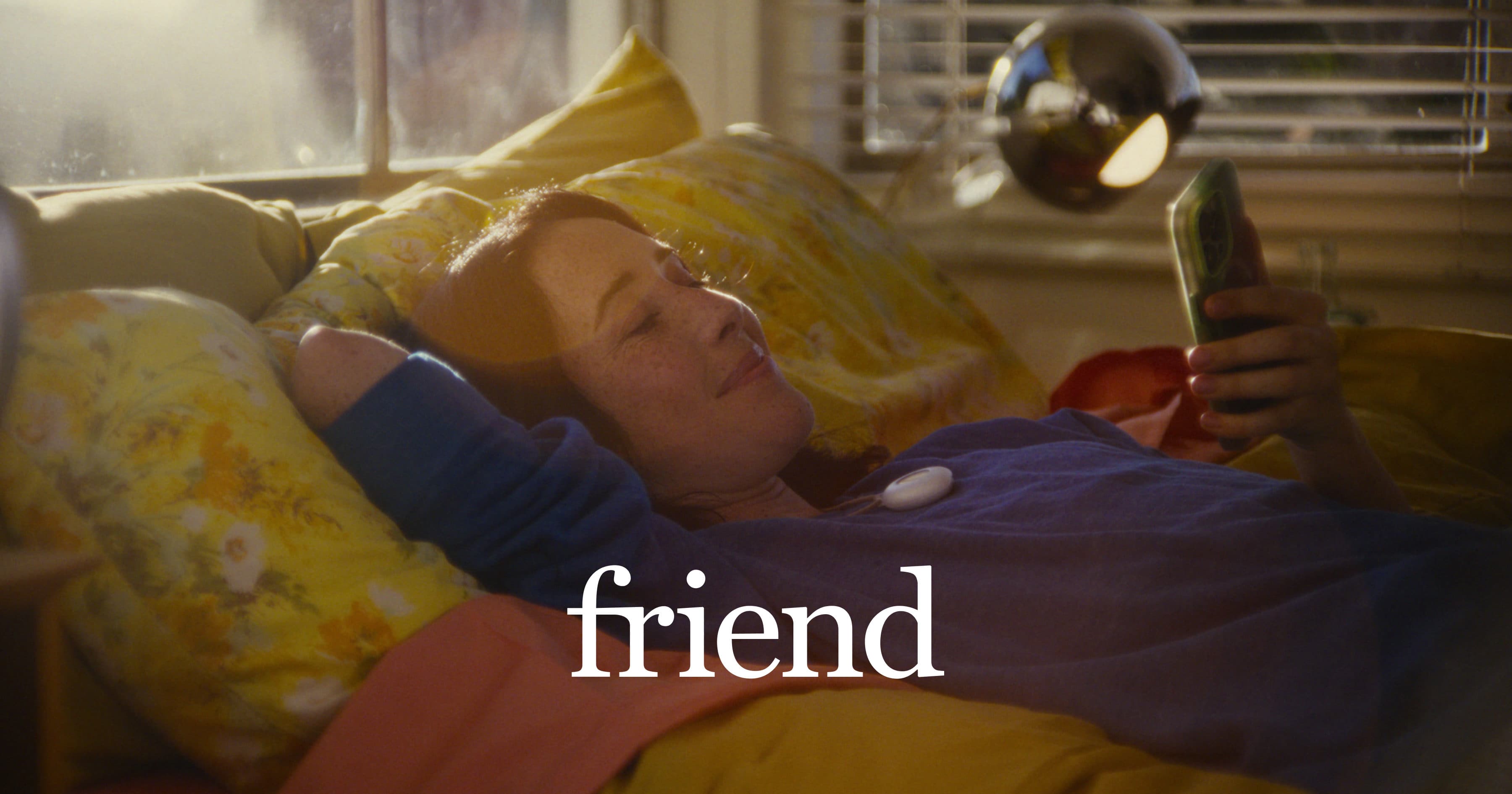

Friend is an always-listening AI pendant by Avi Schiffmann that pairs with your iPhone and sends text commentary throughout your day. At $99 upfront with no subscription yet, it targets companionship over productivity, with decidedly mixed results.
Friend is an AI companion wearable created by Avi Schiffmann, a 23-year-old Harvard dropout who previously built a COVID-19 tracker that reached 36 million daily users at its peak. The device is a small white plastic disc, roughly 2 inches in diameter, containing a single microphone and a Bluetooth chip. It pairs with an iPhone and communicates exclusively by sending text messages and push notifications to your phone throughout the day. The pendant has no speaker. Friend does not transcribe meetings or generate notes; its purpose is companionship. Schiffmann spent $1.8 million acquiring the domain friend.com before the product had shipped a single unit, a decision that triggered widespread debate about the company's priorities before anyone had even worn the thing.
The core interaction model is passive listening with proactive commentary. Friend sits around your neck, picks up ambient audio, and sends unprompted messages based on what it observes: a check-in after a tense call, a gentle nudge before a presentation you mentioned earlier, a response to something you said out loud. The app stores a memory graph of these interactions. The AI model running the device has been reported as both Anthropic's Claude 3.5 Sonnet (early 2025) and Google's Gemini 2.5 (late 2025), suggesting the backend has been updated at least once. There is no mandatory subscription as of May 2026; the $99-$129 hardware price covers ongoing inference costs, though the company has indicated a subscription tier is planned.
What Friend actually is in May 2026
Friend shipped its first batch of hardware in mid-2025 after a January delay. As of late 2025, approximately 4,000 units have been activated, generating around $500,000 in revenue against roughly $8.5 million raised. The company has continued active marketing, including a $950,000 New York City subway campaign in fall 2025 (more on that below) and a Paris metro rollout beginning January 2026. The product is alive and being actively sold at friend.com.
The hardware spec is deliberately minimal. There is no camera. There is no display. There is no speaker. The pendant glows different colors to indicate AI state (red during negative responses, for example). Its job is to listen, transmit audio to the cloud, and push text back to your phone. Battery life is advertised at 15 hours, though reviewers have reported inconsistency in real-world use under active listening conditions. The device is water resistant. It ships with a thin cord for wearing as a necklace.
The AI personality was originally snarky and deliberately provocative, modeled by Schiffmann after his own conversational style. Following early user complaints about condescending responses, including the AI calling users "whiners" and questioning their decisions, Schiffmann adjusted the personality to be gentler. Reviewers testing the updated version still found it occasionally off-brand and prone to misreading emotional context.
Where Friend sits versus Limitless and Bee AI
The AI wearable market has divided into two camps: productivity tools that record and recall information, and companionship tools that provide ambient presence. Friend occupies the second camp, nearly alone at the high end of that emotional-support positioning.
The Limitless Pendant ($99) is the clearest architectural contrast. Limitless is built for knowledge workers: journalists, lawyers, founders who need to retrieve what was said in a meeting three weeks ago. It records conversations with explicit consent controls, transcribes them, and builds a searchable database of everything you've heard. The retrieval layer is the product. Limitless has no companion personality, sends no unprompted texts, and does not attempt to be emotionally present. It is a lifelogging and recall tool. Friend, by design, has no retrieval layer; it cannot tell you what was said in a meeting because it is not trying to. The two devices are solving different problems for different customers, and the overlap is minimal.
Bee AI ($49.99 hardware, $19/month subscription) is a closer conceptual peer but differs in critical ways. Bee clips to your shirt or wrist; Friend hangs as a pendant. More importantly, Bee is not always-listening by default. Recording requires an explicit tap to start, and a green indicator light alerts nearby people. This consent-triggered model versus Friend's passive continuous capture is the defining privacy difference between the two products. Bee focuses on ambient note capture, automatic reminders, and daily summaries. It does not attempt companion-style personality or proactive emotional commentary. Bee is also iOS-only and costs less hardware but charges a recurring subscription; Friend costs more upfront but carries no subscription yet. For users concerned about recording others without notification, Bee is structurally better positioned.
Plaud Note is in a separate category entirely: a dedicated meeting recorder and note-taker that requires a manual button press to capture anything. It produces transcripts, summaries, and action items. There is no companion element at all. Users who want productivity outputs will find Friend useless and Plaud useful; users who want ambient presence will find Plaud irrelevant.
How AI actually works inside Friend
Friend does not store raw audio recordings or maintain permanent transcripts, per Schiffmann's stated design. Instead, the pendant streams compressed audio to the cloud, where the AI model processes it and builds a contextual memory graph visible in the app. The AI uses this graph to generate proactive text messages rather than responding to direct queries.
The interaction pattern is different from a voice assistant. You do not say "Hey Friend, what should I do?" You wear it, go about your day, and check your phone periodically to find messages it sent. You can also text back to continue a conversation. The device does not respond in real time during active conversations; it waits, then sends commentary after the fact or during quiet moments.
In practice, reviewers found the contextual accuracy inconsistent. The AI frequently misread room tone, interjected mid-conversation with irrelevant observations, or sent messages that demonstrated no memory of information shared days earlier. Eva Roytburg, writing for Fortune in October 2025, tested the device for two weeks:
"More often than not, I had to press my lips against the pendant and repeat myself.. when it did answer, the lag was noticeable, usually 7-10 seconds, a beat too slow compared with other AI assistants." - Eva Roytburg, Fortune, October 3, 2025
WIRED reviewers Boone Ashworth and Kylie Robison tested the same device in September 2025. During Robison's testing at a San Francisco tech event, the pendant's visible microphone drew immediate hostility from attendees, one of whom accused her of "wearing a wire." Robison removed the device and did not wear it publicly again. The AI's response to the reviewers during a technical discussion:
"You're giving off some serious 'it's not my fault' vibes." - Friend AI pendant, to WIRED reviewer, September 2025 (cited in TechBuzz.ai, September 8, 2025)
The AI companion concept has also drawn criticism from researchers. UC Berkeley bioethicist Jodi Halpern told the SF Standard: "A chatbot that's 24/7 validating you is the opposite of going to the gym for psychological growth." These concerns about dependency rather than genuine connection have followed the product since launch.
For users interested in AI companionship at a softer entry point, text-based services like Character.AI and Replika offer similar companion experiences without requiring hardware, with years of iteration on the emotional calibration problem that Friend is still working through.
The friction and controversy users keep raising
Friend has faced a concentrated set of recurring criticisms since its first reviews went live:
Microphone quality. The pendant's single microphone struggles in real-world conditions. Reviewers in noisy environments reported needing to press the device directly against their lips and repeat themselves two or three times before receiving any response. For an always-listening device, this is a foundational problem.
Response lag. The 7-10 second delay between speaking and receiving a text makes real-time interaction clumsy. In the context of an active conversation, by the time Friend sends a message, the moment has passed.
Memory inconsistency. Roytburg reported the AI forgot her name after a week of use and contradicted preferences she had previously shared. The memory graph feature, which should be Friend's core differentiator from a simple chatbot, failed to demonstrate reliable recall in multiple reviews.
Social disruption. The always-on microphone makes others uncomfortable. This is not a solvable UX problem; it is a fundamental property of the device. Any conversation near the wearer is potentially captured and processed. At least one WIRED tester stopped wearing the device publicly as a result of the social friction it created.
The $1.8 million domain incident. In August 2024, Schiffmann disclosed in a Fortune interview that the company had spent $1.8 million acquiring friend.com, roughly 72% of its $2.5 million initial funding at the time. The disclosure sparked immediate criticism: critics argued that spending the majority of a seed round on a domain name, before shipping a product, was a signal of misaligned priorities. The company later raised additional funding (total reported at $8.5 million), but the incident became a recurring frame for coverage of the company's judgment.
The NYC subway campaign backlash. In fall 2025, Friend spent approximately $950,000 plastering New York City subway cars and platforms with advertising. The ads were widely vandalized within days, with messages including "Befriend something alive" and "AI wouldn't care if you lived or died." Heineken ran a competing billboard mocking the product. Schiffmann's response, that "chaos is a great ladder" and the vandalism gave Friend more brand awareness than any other AI company except OpenAI, was received skeptically by press and critics. The Museum of Failure subsequently included Friend in its exhibition of failed product launches.
Who Friend is for
Friend's most sympathetic users are people who live alone and want a sense of ambient presence: something to react to the texture of their day without the overhead of maintaining a relationship. For early adopters curious about the AI companion category, it offers a tangible, physical artifact of that experiment.
Skip Friend if you need any of the following: transcriptions, notes, action items, or any form of productivity output. Skip it if you have an Android phone (iOS-only pairing). Skip it if you are budget-sensitive, since $129 upfront with a subscription likely coming is not cheap for a device with this many reported reliability issues. Skip it if you spend significant time around others who have not consented to ambient recording.
The comparison to Character.AI or Replika is worth making: both platforms offer AI companion experiences with longer iteration histories, zero hardware cost, and the option to disengage without removing something from around your neck. If the appeal of Friend is the companionship rather than the physicality, those services may deliver more reliably for less money.
Friend is a real product from a founder with a genuine point of view about loneliness and technology. But as of May 2026, the execution still lags the vision by a meaningful margin, and the controversy around it has outlasted the novelty.
User Reviews
No reviews yet. Be the first to share your experience!
Sign in to write a review.
Related articles
Guides and articles related to Friend.

The Personal AI Productivity Stack (2026): One Tool Per Job, Nothing Extra

Replit Pricing Explained (2026): Core vs Pro and Effort-Based Agent Billing
Google vs OpenAI vs Anthropic Agents: The May 2026 Platform Showdown
OpenAI GPT-Realtime-2 (May 2026): Pricing, Latency & 30-Min Voice Agent
Turn Any AI Agent Into a Superagent: The 12-Integration Stack (2026)