Sell AI-Generated Short Films on TikTok Shop, Instagram & YouTube (2026)
How to Sell AI-Generated Short Films on TikTok Shop, Instagram & YouTube (2026)
Selling AI videos on TikTok Shop, Instagram Shop, and YouTube Shopping is the cleanest creator-economy arbitrage of 2026. Production cost per 30-second clip can sit under $1.50 of model spend, while affiliate commissions on TikTok Shop average 13.02% per the 2026 InfluenceFlow creator payment guide, and one viral AI-driven fragrance push reportedly generated £400,000 (about $500,000) in 30 days as the 11th highest-performing product on UK TikTok Shop, per Hooc AI's 2026 case-study writeup. This tutorial is the operator-level playbook: tools, platforms, legal rules, real numbers, 90-day ramp.
TL;DR
AI short films now drive 50%+ of TikTok Shop GMV in 2026
Realistic stack cost: $80 to $360 per month, all-in
TikTok Shop average affiliate commission: 13.02% in 2026
YouTube Shopping enables at 500 subscribers in 2026
EU AI Act Article 50 deepfake disclosure binding August 2, 2026
What does "selling AI short films" actually mean in 2026?
Selling AI short films means using a generative video model (Sora 2, Kling 3.0, Veo 3.1, Higgsfield, Runway Gen-4.5) to produce 15 to 90 second narrative clips, then attaching them to a paid revenue surface: TikTok Shop affiliate links, Instagram Reels product tags, YouTube Shopping affiliate, or direct-to-fan sales on Whop or Stan Store. The film itself is the bait; the commerce link is the hook.
The unit ranges from a 6-second product reveal that loops on a TikTok Shop promo to a 60-second cinematic mini-trailer for an affiliate product collection. What changed in 2026 is that the underlying models can now output coherent, usable clips with stable subjects, real camera motion, and synced lip movement. Sora 2 ships at $0.10/second for 720p via API, per AI Free API's Sora 2 pricing breakdown, which puts a 10-second clip at $1.00. Kling 2.6 Standard at 5 seconds runs about $0.09 on the $5.99/month Standard plan per AI Tool Analysis's 2026 Kling pricing. The marginal cost per finished short film, including upscaling and edit, sits between $0.50 and $5.
The revenue side scaled in parallel. TikTok Shop's projected 2026 GMV crossed $112.2 billion per Resourcera's 2026 TikTok Shop statistics, and 60% of that volume comes from creator-driven short video. YouTube cut its Shopping affiliate threshold from 10,000 to 500 subscribers in 2026 per YouTube's official blog post. Instagram Reels relaunched native creator affiliate tagging in March 2026 per JoinBrands' 2026 Instagram update. Three checkout surfaces, one creative engine.
What platforms pay creators for AI shorts (and how much)?
Five platforms pay measurable commissions on AI shorts in 2026: TikTok Shop, Instagram Reels affiliate tags, YouTube Shopping affiliate, Whop (direct-to-fan communities), and Stan Store (link-in-bio sales). Average commissions range from 5% on Amazon-routed Instagram tags to 30% on TikTok Shop premium categories, with direct-to-fan platforms keeping 90 to 100% of the sale price net of payment fees.
Platform | Threshold to monetize | Typical commission / take | Source |
|---|---|---|---|
TikTok Shop Creator (US) | 1,000 followers, 18+, ID verification | 10-30% per sale, 13.02% platform avg | |
Instagram Reels affiliate tags | Eligible Reels creator in US, BR, IN, ID, TH | 1-10% (brand-set), Meta takes 0% | |
YouTube Shopping affiliate | 500 subscribers, in YPP, 12 listed countries | ~15% avg, brand-set, paid via AdSense | |
Whop (digital products + community) | None; Stripe / payout account | 3% Whop fee + 2.7% + $0.30 processing | |
Stan Store (link-in-bio sales) | None; $29/mo Creator plan | 0% transaction fee on paid plans | |
Beacons (link-in-bio + email) | None; free tier available | 9% transaction fee on free plan, lower on paid |
Three honest reads on this table. First, TikTok Shop is the highest-velocity surface in 2026 because shoppable videos already account for roughly 50% of platform GMV, per the May 2026 Net Influencer report. Second, the top 10% of TikTok Shop creators average $48,500/month per the 2026 InfluenceFlow earnings guide; that's a fat tail, not a median, but the top decile is achievable with disciplined output. Third, Whop and Stan Store are the highest-margin surfaces because the take rate is near zero, but they require you to sell something the audience will buy directly (a course, a community, a templates pack), not just a click-through to someone else's product.
Are AI shorts allowed on TikTok Shop in 2026?
Yes, AI short films are allowed on TikTok Shop in 2026, but content that uses AI to depict realistic people, voices, or scenes must carry a clear and prominent on-video AI label, not just a caption note. TikTok's content policy treats undisclosed synthetic media as a removal-eligible offense, and Symphony-generated content is auto-labeled.
Specifics that matter:
Mandatory AI label. When AI generates or significantly alters people, voices, or realistic scenes, you must add a visible "AI-generated" label on the video itself, per TikTok's seller content policy. Caption-only disclosure does not count.
Posting caps under 5K followers. TikTok Shop creators with under 5,000 followers can post only 5 shoppable videos per week, per the ShortFormNation 2026 guide. Build the follower base first.
Daily shoppable limits from May 11, 2026. Effective May 11, 2026 TikTok introduces daily posting limits for shoppable content for all US merchants and creators, per Darkroom Agency's TikTok 2026 rules summary. Quality scores will start to outweigh raw volume.
Misleading AI = ban. Misleading AI content (deepfaked endorsements, fake reviews, impersonated public figures) is prohibited entirely, not just label-required. The penalty is product takedown, creator suspension, or commission clawback.
Symphony auto-label. If you build inside TikTok Symphony's Creative Studio, output is automatically labeled as AI-generated and runs through a safety review, per TikTok's Symphony newsroom post.
Practical workflow: drop a small "AI-generated" caption in the lower third of every short film, plus toggle TikTok's native "AI-generated content" switch on upload. This is the same pattern recommended for the AI UGC tutorial for brands. It costs you 2 seconds of caption real estate and moves you from "policy risk" to "demonstrably compliant."
What's the full AI short-film tool stack?
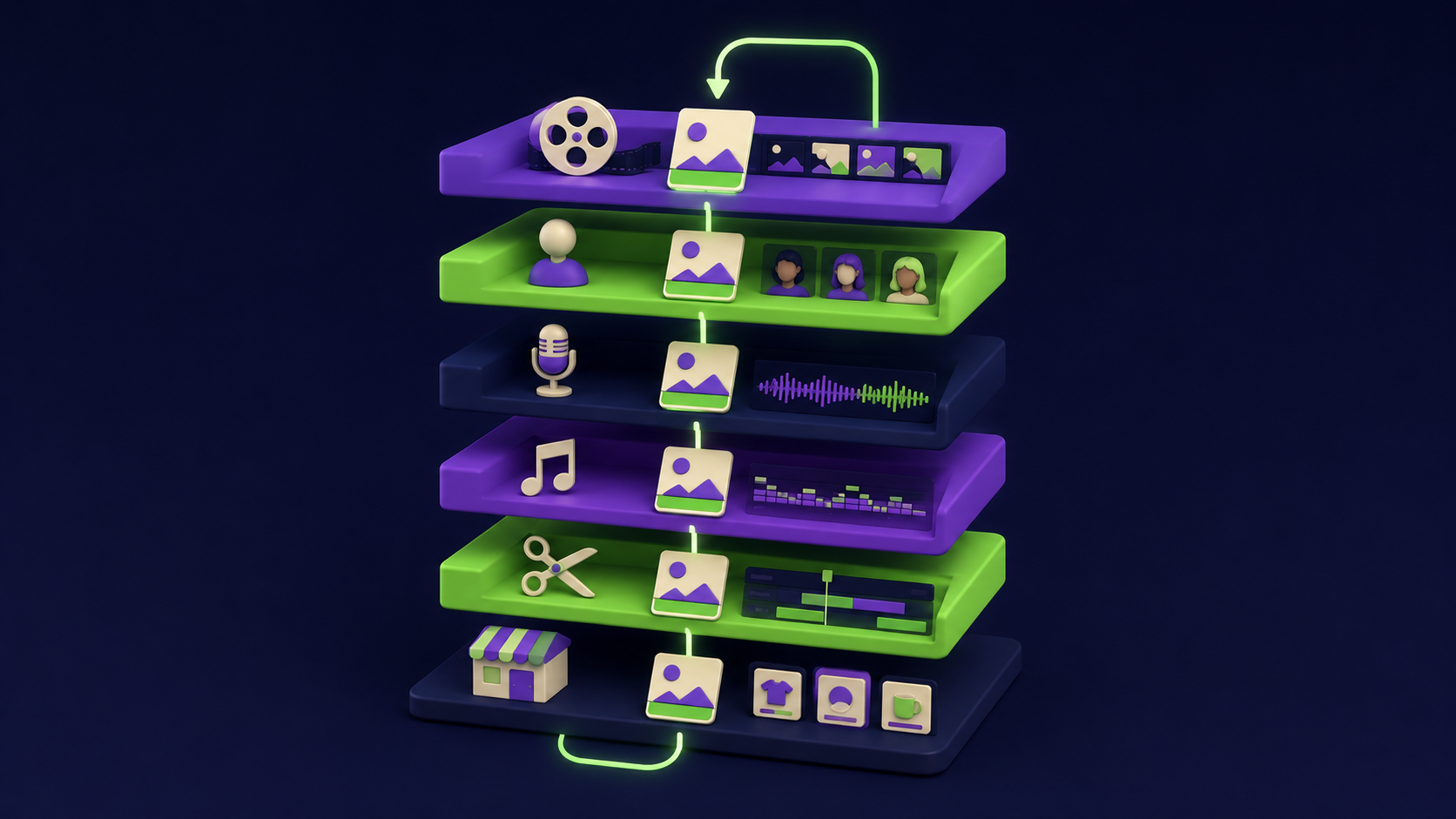
The 2026 AI short-film stack has six layers: long-form video generation, avatar / spokesperson, voice, music, post-edit, and direct-to-fan storefront. You do not need every tool in every layer to start. Pick one per row, ship 10 shorts, then expand based on what your niche actually demands.
Layer | Tools (2026) | Entry price | Notes |
|---|---|---|---|
Long-form AI video | Invideo Invideo Agent, Kling 3.0, Runway Gen-4.5, Pika 2.2, Luma Ray3, Adobe Firefly Video, | $5.99-$30/mo | Sora 2 API: $0.10/sec 720p. Kling Standard: $5.99/mo |
Avatar / spokesperson | $9.99-$29/mo | Talking-head avatar reads script in your voice; for "creator on camera" feel | |
AI UGC ad-style platforms | $19-$220/mo | One-click avatar UGC for TikTok Shop product promos | |
Voice (TTS / cloning) | $5-$22/mo (commercial) | ElevenLabs Starter enables commercial use at $5/mo | |
Music (commercial) | $10-$30/mo | Suno Pro at $10/mo includes commercial rights; Udio walled-garden post 2026 deal | |
Post-edit / captions | $9.99-$40/mo | Burn-in captions, multi-aspect export, hook scoring | |
TikTok-native AI | TikTok Symphony Creative Studio | Free for ad accounts | Image-to-video, text-to-video, auto-dub, auto-label |
Direct-to-fan storefront | Whop, Stan Store, Beacons | $0-$29/mo + take rate | Whop ~5.7% all-in; Stan 0% on paid; Beacons 9% free / lower paid |
Automation (auto-pipeline) | $0-$29/mo | Self-host n8n on VPS for $6-$8/mo | |
Hosting (creator dashboard / n8n) | $6-$25/mo | n8n self-hosted, sales dashboard, asset CDN |
One framing note: Sora 2 is the leader on cinematic realism in 2026 but the most expensive per second; Kling 3.0 is the value pick at $5.99/mo with commercial use included on every paid tier per AI Tool Analysis's 2026 Kling pricing; Higgsfield Plus at $39/mo gives 1,000 credits and unlimited access to specific high-end models like Wan 2.6 per Higgsfield's pricing page; Runway's $28/mo Pro plan now bundles Veo, Kling, Seedance, and FLUX into one subscription per Runway's pricing page, which makes it the best multi-model entry point.
Step-by-step: how to make + sell your first AI short in one weekend
This walkthrough produces one 30-second AI short film, attaches it to a TikTok Shop affiliate product, and ships it live in roughly 4 hours of work spread across a weekend. Total tool spend for the first short: under $10. Tools used: Kling 3.0 ($5.99/mo) for video, ElevenLabs Starter ($5/mo) for voice, Suno Pro ($10/mo) for music, Submagic Starter ($20/mo) for captions, TikTok Shop Creator account (free).
Pick a TikTok Shop product (15 minutes, Saturday morning). Open the TikTok Shop Affiliate Center, filter by "high commission" and your niche. Pick a product with: at least $20 retail price, 15%+ commission, fewer than 200 affiliate creators already on it, and a clear product photo. Avoid anything in restricted categories (CBD, weapons, supplements requiring health claims). Save the product link.
Write the 30-second script (45 minutes). Structure: 3-second hook ("This is the one thing nobody tells you about [problem]"), 18-second story with a single concrete moment, 5-second product reveal, 4-second CTA ("Tap the cart to grab one"). Write in voice memos first, transcribe second; the cadence comes out more conversational than typing it cold.
Generate voice (10 minutes). In ElevenLabs, paste the script into Speech Synthesis. Pick a voice from the library or use Instant Voice Clone (Starter, $5/mo includes commercial rights per the ElevenLabs pricing page). Set Stability 40, Similarity 75, Style 0. Render WAV. Total render time: 30 seconds.
Generate the cinematic shots (60 minutes). Break the 30-second script into 4 to 6 shot beats. In Kling 3.0 Standard, prompt each beat with: subject + action + camera move + lighting + style. A 5-second Kling 3.0 Standard clip costs about 20 credits ($0.18 on the $5.99 plan per AI Tool Analysis's 2026 Kling pricing). For the product reveal beat, use the official product photo as image-to-video input so the product looks identical to the shop listing.
Generate background music (10 minutes). In Suno Pro ($10/mo, includes commercial rights per Suno's pricing page), describe the vibe ("warm minimal cinematic, soft piano, 90 BPM, 35 seconds, no vocals"). Generate 4 versions, pick the one with the cleanest intro hit on second 0.
Edit, caption, and label (45 minutes). In Submagic or CapCut Pro ($9.99/mo per CapCut), assemble the Kling beats over the ElevenLabs voiceover, drop the Suno music underneath at -16 LUFS. Auto-caption in Submagic's "Beast" or "Tracy" style. Add a small "AI-generated" lower-third per TikTok policy. Export 9:16 1080p.
Upload to TikTok with the affiliate link (15 minutes). In TikTok app, post the video, attach the affiliate product from your Shop Creator dashboard, write a hook caption matching the on-screen first sentence, toggle the "AI-generated content" switch on upload. Schedule for the slot with highest engagement on your account (Tuesday 7pm or Saturday 11am for most accounts).
Repeat for Instagram Reels and YouTube Shorts (30 minutes). Re-export the same master at 1:1 for Feed and 9:16 for Shorts. Tag the same product on Instagram (if you're an eligible creator in US/BR/IN/ID/TH per JoinBrands' 2026 Instagram update), and attach the YouTube Shopping affiliate link if your channel is at 500+ subs in YPP per YouTube's official blog post.
By the time you've shipped 5 shorts following this loop, expect each subsequent short to take roughly 90 minutes start to finish. By short 30, with a basic n8n workflow handling steps 3-6, the human-time-per-short drops to 25 minutes.
How do you pick a profitable niche for AI shorts?
The profitable niches for AI shorts in 2026 share three traits: high TikTok Shop commission rates (15%+), products under $50 with broad appeal, and a niche where short-form storytelling beats live demo. The five highest-density niches in 2026 are beauty and fragrance, pet, kitchen and home, supplements (within ad-policy limits), and small-ticket apparel.
The decision frame: a niche is profitable when you can answer yes to all four:
Demand check. The product category appears in TikTok Shop's top 100 GMV list for the month. Kitchen gadgets and beauty have dominated 2026, with the UK fragrance push hitting £400,000 in 30 days per Hooc AI's 2026 case study.
Margin check. Commission is at least 15%, ideally 20%+. Skip 5% commodity categories unless you're producing volume.
Story check. The product has a "moment" you can dramatize in 6 seconds (the satisfying click, the unboxing whiff, the kitchen reveal). If the only selling point is a spec sheet, skip it.
Competitor check. Search the product on TikTok Shop's affiliate center. Fewer than 200 creators on it = white space. Over 1,000 = saturated; pick a sibling product.
One secondary heuristic: pick a niche you'd genuinely scroll for unprompted. The cadence of the script and the choice of cinematic beat both compound when you actually consume the format. The Justin Levitt $3,000/mo faceless tech channel writeup attributes most of its compounding to picking a niche the operator already binge-watched at 1.5x. Your taste is a content moat.
How do you write scripts and storyboards that convert?
Converting AI short film scripts follow a 4-beat structure: hook (3 seconds), specific moment (15-18 seconds), product reveal (5 seconds), CTA (3-4 seconds). Storyboards translate each script beat into one camera move plus one lighting note plus one subject action. The script controls watch time, the storyboard controls the AI prompt.
The script template that ships:
Hook (0:00-0:03). One sentence with a concrete number, a contrarian claim, or a name no one expects. Example: "I bought this $14 kitchen gadget and now my partner won't let me return it." Bad hook: "Check out this amazing product." Good hook: anything that includes a price, a person, or a verb the viewer hasn't heard 100 times this week.
Specific moment (0:03-0:21). One scene, one sensory detail. The viewer should feel something happen. Bad: "It's so easy to use and changes your life." Good: "I dropped it in the sink, ran the tap, and the burned cheese came off in one wipe." Specificity beats summary.
Product reveal (0:21-0:26). The product is now on screen, named, with the hero shot composition matching the TikTok Shop listing. Use the official product photo as image-to-video input so the AI render matches what the buyer sees in the cart.
CTA (0:26-0:30). Imperative verb. "Tap the cart to grab one." "Link in the orange basket below." Avoid "check out the link in my bio" because TikTok Shop affiliate links live on the video itself, not in bio.
For the storyboard layer, each beat becomes a single Kling / Sora / Runway prompt with: subject, action, camera, lighting, style. Example storyboard line: "Hand reaching into a sunlit kitchen drawer, slow dolly-in, golden hour through window blinds, shallow depth of field, photorealistic, 85mm lens look, 5 seconds, 9:16." Treat the storyboard as a prompt brief, not a Pinterest mood board. The deeper craft of this is in the AI Video Generator Prompting workflow.
How do you handle music rights for AI-generated soundtracks?
For AI-generated soundtracks in 2026, you need a paid Suno tier ($10/mo Pro or $30/mo Premier) for commercial rights, OR a paid Udio tier subject to its post-licensing-deal walled-garden constraints. Free-tier output from either platform is non-commercial. Using a copyrighted track without sync rights remains a TikTok takedown trigger and an Instagram revenue strike.
The 2026 reality is more nuanced than "AI = free music":
Suno Pro ($10/mo) and Premier ($30/mo) include commercial rights per Suno's pricing page. Pro gives 2,500 monthly credits (~500 songs); Premier gives 10,000 credits (~2,000 songs). Songs created on a paid plan retain commercial rights even if you cancel later.
Suno's Warner Music partnership was announced November 2025 per Billboard's licensing-deal analysis; current v5.x and earlier models may be deprecated when the new licensed models ship.
Udio's licensing deal pivots it to a fan-engagement walled garden per the same Billboard analysis, meaning content generated on Udio post-deal may not be exportable for TikTok / Instagram / YouTube use. Verify export rights before committing a workflow to Udio.
You license the use, you do not own the song, per Suno's Terms of Service. The output is generated by the model, so the platform retains ownership and grants you a commercial-use license. Practical effect: don't try to register your AI track with ASCAP / BMI as your composition.
For the safest fallback, use TikTok's Commercial Music Library (free for business accounts) or YouTube's Audio Library when soundtracking shorts that promote affiliate products. Keep AI-generated music for the long-form content where you control the platform.
Practical rule of thumb: every TikTok Shop short uses TikTok's Commercial Music Library or your own paid Suno track. Every YouTube Short uses YouTube Audio Library or paid Suno. Every Instagram Reel uses Instagram's commercial-cleared library or paid Suno. Cost discipline + rights discipline = no takedowns at scale.
How do you scale to 30+ videos/week with auto-pipeline?
Scaling to 30+ AI short films per week requires automation, not labor. The lever is an n8n (or Make.com) pipeline that turns a one-row Google Sheet entry into a published TikTok / Instagram / YouTube short. With the pipeline, founder time per video drops from ~90 minutes to ~10 minutes (mostly QA and approval), and you can ship 6-8 shorts per day on a single laptop.
The reference auto-pipeline:
Trigger. A new row appears in a Google Sheet titled "Short Brief" with columns: niche, product link, hook angle, target platform.
Script generation. n8n calls Claude or GPT-5 with the brief plus your script template, generates 3 hook variants and 1 full 30-second script. Output drops into a Notion approval page.
Voice + shot rendering. Approved script triggers ElevenLabs API (voice render), then a parallel branch firing 4-6 Kling / Sora / Runway image-to-video calls (one per beat). Renders complete, files land in a /renders bucket.
Music + edit. n8n calls Suno API for a 35-second backing track in the brief's vibe. A small FFmpeg step concatenates the beats over the voice and music, burns in captions and the AI-generated lower-third label, exports 9:16 1080p plus 1:1 backup.
Upload. n8n posts to TikTok via the official Content Posting API, to Instagram via the Graph API Reels endpoint, to YouTube via the Data API resumable upload. Affiliate product gets attached on TikTok via the Shop Affiliate API. Status updates back to the Google Sheet row.
Reporting. A daily n8n cron pulls TikTok Shop affiliate sales, Instagram Reels insights, and YouTube Shopping clicks back into a single Looker Studio dashboard. Each short is graded by GMV, hook rate, and watch time.
Run n8n self-hosted on an $8/mo Hostinger KVM 4 or a $6/mo Vultr instance. The exact pattern is documented in the n8n MCP + Claude Code setup guide, with the agent layer built on the same architecture as the OpenAI GPT-Realtime 2 voice agent setup.
One scaling caveat: TikTok introduced daily shoppable post limits effective May 11, 2026 per Darkroom Agency's TikTok 2026 rules summary. The era of carpet-bombing 50 shoppable posts/day on one account is over. Operate 3-5 accounts, each within posting limits, each with a distinct narrative voice. Quality + multi-account beats single-account spam.
What's the realistic 30/60/90-day income ramp?
The honest 90-day curve for an AI short-film operator with no existing audience is: month 1 = $0-$300 (learning + portfolio), month 2 = $300-$2,000 (first viral hits + commission flow), month 3 = $1,500-$8,000 (compounding, multi-platform, first storefront sales). The variance is wide because virality is binary; one outlier video can 10x the month. The cases below are real-world anchors, not promises.
Phase | Activity | Realistic outcome | Source / case |
|---|---|---|---|
Days 1-30 | Set up stack, ship 30 shorts across TikTok + Reels + Shorts; pick 1 niche; apply to TikTok Shop Creator at 1K followers | 0-1 viral video, $0-$300 affiliate commission, 1K-5K followers | Average TikTok Shop commission 13.02% per InfluenceFlow 2026 |
Days 31-60 | Double output to 50-60 shorts; cut losers, double on what works; cross-post winners to YouTube Shopping (500+ subs gets you affiliate access) | $300-$2,000 in commissions; first inbound DMs from brands | Tech-niche faceless channel: $3,200/mo at 400K monthly views per Levitt 2026 writeup |
Days 61-90 | Add Whop or Stan Store storefront selling a "AI Shorts Starter Kit" or niche template pack; productize the pipeline | $1,500-$8,000 across affiliate + direct sales; 1 viral outlier possible | Top-decile TikTok Shop creators avg $48,500/mo per InfluenceFlow 2026 earnings |
Days 91-120 (stretch) | Build n8n auto-pipeline; run 3-5 niche-specific accounts in parallel; productize a community on Whop | $5K-$25K/mo if compounding holds; high variance | Influencer-driven content drove $5.4B GMV in TikTok Shop H1 2025 per Resourcera 2026 |
Two honest framing notes. First, the high-end numbers (the £400K UK fragrance push, the $48,500/mo top-decile creator) are statistical outliers, not the median. Plan around the median outcome (low four figures by month 3) and treat the outlier as upside, not budget. Second, the Justin Levitt $3,200/mo faceless tech channel writeup attributes the bulk of revenue to AdSense, not affiliate; if you're optimizing for direct affiliate / Shop revenue specifically, expect a slower ramp but a higher revenue per view once it kicks in.
What are the legal/disclosure rules in the US, EU, and UK?
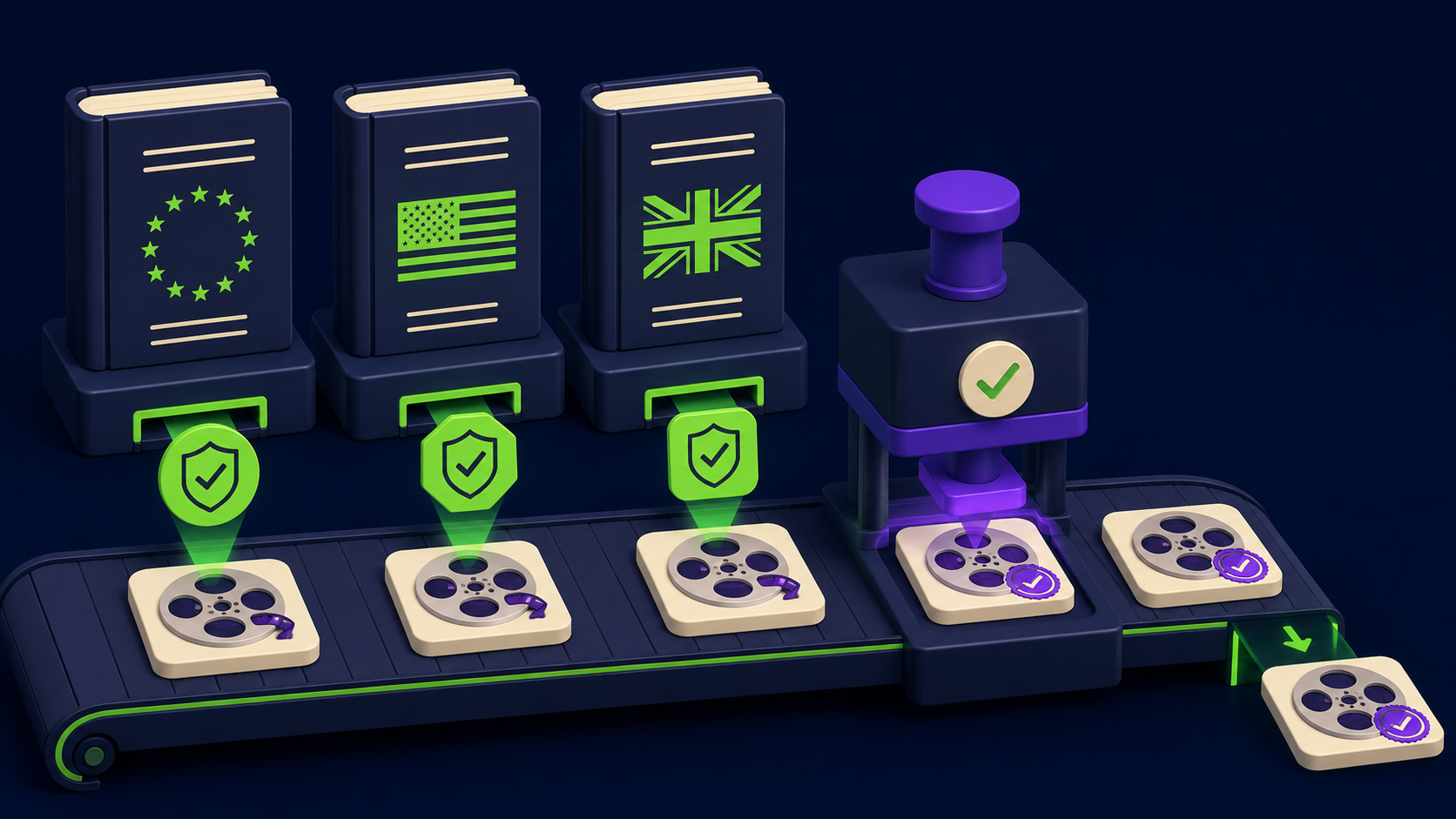
Three regimes govern AI shorts in 2026: the EU AI Act Article 50 (binding August 2, 2026; deepfake disclosure mandatory), the US FTC's October 2024 final rule on fake and AI-generated reviews (already in force; updated AI endorsement guidance May 2026), and the UK's Ofcom Online Safety Act enforcement (synthetic-media labeling expected, child-safety priority). Bake disclosure into every short by default.
EU AI Act Article 50. Per the official Article 50 text, deployers of AI systems generating deepfake image, audio, or video content must disclose the content is artificially generated or manipulated. The deadline is August 2, 2026 per the EU Commission's 2026 labeling timeline. Exceptions exist for evidently artistic, satirical, or fictional work, but a short film promoting a real product to drive a sale does not qualify. The Code of Practice supporting compliance is expected to be finalized May-June 2026 per the EU's Code of Practice page.
US FTC fake-review rule. The FTC's final rule, in effect since October 21, 2024 per Sidley's analysis, prohibits AI-generated consumer reviews and testimonials presented as authentic. Updated FTC AI endorsement guidance from May 2026 per AuditSocials' 2026 brief tightens disclosure for synthetic influencers and AI-edited creator content. Personal liability for the creator is now in scope.
TikTok policy. Per TikTok's seller content policy, AI-altered realistic depictions of people, voices, or scenes must carry a clear and prominent on-video AI label. Caption-only disclosure does not count. Misleading AI content (fake endorsements, deepfaked public figures) is removal-eligible.
UK Ofcom. Per Ofcom's strategic approach to AI, synthetic media is a priority risk under the Online Safety Act 2023. Ofcom's January 2026 enforcement action against X / Grok per Lawyer Monthly's 2026 Grok precedent piece signals the regulator will act on synthetic-content harm, especially involving children or non-consensual imagery.
Practical disclosure pattern. Add a small "AI-generated" caption in the lower third of every short (not just the platform toggle), name the model used in the description (one line is enough), and avoid presenting AI personas as real customers giving testimonials. This pattern satisfies all three regimes simultaneously.
For storefront sales (Whop / Stan Store), add a one-line "Created with AI tools" notice on the product page. It costs you nothing, satisfies disclosure, and pre-empts buyer disputes about "I didn't know this was AI."
Common pitfalls and how to avoid them
Six mistakes recur across AI short film operators in their first 90 days, observed in the Miraflow 2026 monetization analysis and Subscribr's revenue deep dive:
Low-effort mass production triggers demonetization. Per Miraflow's 2026 analysis, thousands of faceless AI channels lost monetization in early 2026 under YouTube's inauthentic content policy. The fix: invest in scripts, real insights, and edit polish. Volume + zero craft = demonetization. Volume + craft = compounding.
Skipping the AI label. One missed label triggers a TikTok takedown and a creator-strike. Bake the lower-third caption into your edit template; never rely on memory.
Generic product pitches without a moment. "This product is amazing" loses to "I dropped it in the sink and the cheese came off in one wipe." Specificity is what stops the thumb.
Using copyrighted music to "save credits." One Universal-flagged track on Reels costs you the audio on every share of that Reel and may strike your IG monetization. Use Suno Pro, TikTok's Commercial Music Library, or the platform-native libraries.
Single-platform dependency. An algorithm change or account ban (TikTok's stricter shoppable-post limits effective May 11, 2026 per the Darkroom Agency 2026 rules summary) can zero you overnight. Cross-post every short to Reels and Shorts; build a Stan Store or Whop list as your owned channel.
No storefront for the audience you build. Affiliate income compounds linearly with views. Direct-to-fan income compounds non-linearly with audience trust. Add a Stan Store or Whop product (template pack, course, community) by month 60-90. The unit economics of a single $47 template pack to 1% of a 10K audience = $4,700 with near-zero marginal cost.
FAQ
Can you actually make money selling AI short films on TikTok Shop in 2026?
Yes, with caveats. TikTok Shop's projected 2026 GMV is $112 billion per Resourcera's 2026 statistics, 60% comes from creator video, and AI-generated shorts already drive viral product wins like the £400,000 UK fragrance push per Hooc AI's 2026 case study. Median creators earn low four figures per month within 90 days; top-decile creators average $48,500/month per InfluenceFlow's 2026 guide.
How much does it cost to start selling AI shorts in 2026?
Under $80/month for the absolute minimum stack: Kling Standard ($5.99), ElevenLabs Starter ($5), Suno Pro ($10), Submagic Starter ($20), CapCut Pro ($9.99), Hostinger KVM 4 ($8), Stan Store Creator ($29 if you want a storefront day one). The $80 floor lets you ship 30+ shorts/month with commercial rights on every layer. A higher-end stack with Sora 2 API access, Higgsfield Plus, and HeyGen runs $200-$400/month.
Do I need to disclose AI on TikTok Shop videos?
Yes. Per TikTok's seller content policy, AI-generated or significantly altered realistic depictions of people, voices, or scenes require a clear, prominent on-video label, not just a caption note. Toggle the "AI-generated content" switch on upload and burn an "AI-generated" caption into the lower third. The EU AI Act Article 50 makes this binding across the EU on August 2, 2026 per the official Article 50 text.
Which AI video tool is best for short films in 2026?
For cinematic realism, Sora 2 leads but is the most expensive at $0.10/second 720p via API per AI Free API's Sora 2 pricing. For value, Kling 3.0 Standard at $5.99/month gives commercial rights and 660 credits per AI Tool Analysis's 2026 Kling pricing. For multi-model flexibility, Runway's $28/month Pro plan bundles Veo, Kling, Seedance, and FLUX per Runway's pricing page. For cinematic camera-control presets, Higgsfield Plus at $39/mo is the specialist pick.
What's the YouTube Shopping affiliate threshold in 2026?
500 subscribers, in-good-standing YouTube Partner Program membership, and based in one of 12 markets (US, Korea, Indonesia, Thailand, Vietnam, Malaysia, Philippines, India, Singapore, Brazil, Taiwan, Japan), per YouTube's official blog post. The threshold dropped from 10,000 to 500 in 2026. Average commission rates run around 15%, brand-set per product. Payouts go through AdSense within 60-120 days to allow for returns.
Can I sell AI short films directly to fans without a brand?
Yes, on Whop, Stan Store, or Beacons. Whop charges 3% + 2.7% + $0.30 processing per Dodo Payments' Whop fees breakdown; Stan Store charges 0% transaction fee on its $29/mo Creator plan per Stan vs Beacons 2026; Beacons charges 9% on its free tier and lower on paid plans. The product can be a templates pack, a community, an unreleased director's cut, or a niche course. Stan Store wins for fast monetization; Whop wins for community-gated subscriptions.
How do I avoid getting demonetized on YouTube for AI content?
Per Miraflow's 2026 monetization analysis, YouTube targets "low-effort, mass-produced" AI content under its inauthentic content policy. The fix: invest in scripts with real insight, edit with care, and disclose AI use in the description. Faceless and AI-assisted is fine; copy-paste mass production is not. The Justin Levitt $3,000/mo tech channel per his 2026 writeup survived because every video had a researched angle, not just a TTS read of a Wikipedia article.
Is Suno music safe to use commercially on TikTok Shop and YouTube?
Yes on the Pro ($10/mo) or Premier ($30/mo) plans, which include commercial rights per Suno's pricing page. Free-tier output is non-commercial. You hold a commercial-use license, not ownership; you cannot register the song with ASCAP / BMI as your composition. After Suno's November 2025 Warner Music partnership per Billboard's analysis, current models may be deprecated when licensed models ship; archive your tracks now for continuity.
How long does one AI short film take to make end-to-end?
First short: 4 hours including learning curve. After 5 shorts, ~90 minutes per video manually. After 30 shorts with a basic n8n pipeline doing voice + render + edit + upload, founder time drops to roughly 25 minutes (script approval + final QA). The deeper documentation of the pipeline is in the n8n MCP + Claude Code setup guide.
What niches make the most money on TikTok Shop with AI shorts?
Beauty and fragrance (the £400K UK fragrance push per Hooc AI's 2026 case), kitchen and home gadgets, pet products, supplements (within ad-policy limits), and small-ticket apparel. The pattern: under $50 retail, broad appeal, a sensory or visual moment you can dramatize in 6 seconds, 15%+ commission. Skip categories where the only selling point is a spec sheet or where competitor density is over 1,000 affiliates per product.
References
Hooc AI, "How AI-Generated TikTok Shop Videos Are Making Thousands in Sales." hooc.ai
InfluenceFlow, "TikTok Creator Payment Structure Guide 2026." influenceflow.io
InfluenceFlow, "TikTok Creator Earnings Breakdown 2026." influenceflow.io
ShortFormNation, "TikTok Shop Creator Program 2026." shortformnation.com
TikTok Seller US, Content Policy. seller-us.tiktok.com
Darkroom Agency, "TikTok New Rules 2026." darkroomagency.com
TikTok Newsroom, Symphony updates. newsroom.tiktok.com
YouTube Blog, "Earn earlier: expanding YouTube Shopping to creators with 500+ subscribers." blog.youtube
JoinBrands, "Instagram Reels Now Has Native Affiliate Commerce." joinbrands.com
Resourcera, "TikTok Shop Statistics 2025-2026." resourcera.com
Net Influencer, "AI Search Visibility Index: TikTok Shop Agencies, May 2026." netinfluencer.com
AI Free API, "Sora 2 API Pricing & Quotas 2026." aifreeapi.com
AI Tool Analysis, "Kling AI Pricing 2026." aitoolanalysis.com
Higgsfield AI, Pricing page. higgsfield.ai/pricing
Runway, Pricing page. runwayml.com/pricing
Pika, Pricing page. pika.art/pricing
Luma Labs, Dream Machine pricing. lumalabs.ai/pricing
Adobe Firefly, Plans. adobe.com/products/firefly/plans
Suno, Pricing page. suno.com/pricing
Suno Terms of Service. suno.com/terms-of-service
Billboard, "What the Suno and Udio Licensing Deals Mean." billboard.com
ElevenLabs, API pricing. elevenlabs.io/pricing/api
Submagic, Pricing. submagic.co/pricing
Captions, Pricing. captions.ai/pricing
Whop fees breakdown (Dodo Payments). dodopayments.com
Stan Store vs Beacons 2026. stan.store
EU AI Act Article 50 (transparency obligations). artificialintelligenceact.eu
EU AI Act 2026 labeling timeline (August 2, 2026). weventure.de
EU Code of Practice on AI-generated content. digital-strategy.ec.europa.eu
Sidley, "FTC's New Rule on Fake and AI-Generated Reviews." datamatters.sidley.com
AuditSocials, "FTC AI Endorsement Rule May 2026." auditsocials.com
Ofcom, Strategic Approach to AI. ofcom.org.uk
Lawyer Monthly, "The Grok Precedent: Ofcom's Nuclear Option." lawyer-monthly.com
Justin Levitt, "How I Built a Faceless YouTube Channel That Makes $3,000/Month Using AI." medium.com/activated-thinker
Miraflow, "Can You Monetize Faceless YouTube Channels Made Entirely with AI?" miraflow.ai
Related from Vantaige
Get the best new AI tools and guides, weekly
One short email a week. The tools worth trying, the guides worth reading, nothing else.
No spam. Unsubscribe anytime.
Aymen B
Contributing writer at Vantaige, covering the AI tools ecosystem.